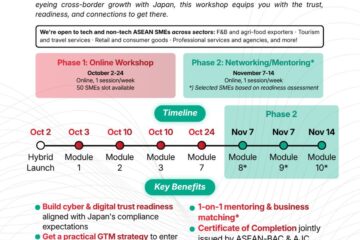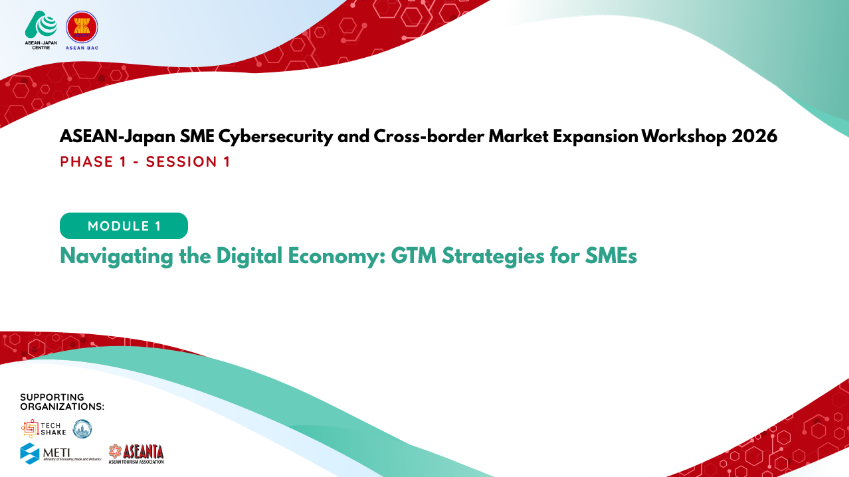
The ASEAN-Japan Centre (AJC), in collaboration with the ASEAN Business Advisory Council (ASEAN-BAC), convened the first live workshop session of the ASEAN-Japan SME Cybersecurity and Cross-border Market Expansion Workshop on Saturday, 3 October 2026.
Under Module 1: Navigating the Digital Economy: GTM Strategies for SMEs, participating enterprises explored how to identify realistic opportunities in the Japanese market, strengthen their cybersecurity and digital-trust readiness, and translate these insights into a focused go-to-market (GTM) strategy.
Finding a realistic first customer in Japan
The session began by encouraging participants to look beyond the overall size of the Japanese market and instead identify the most realistic first customer for their business.
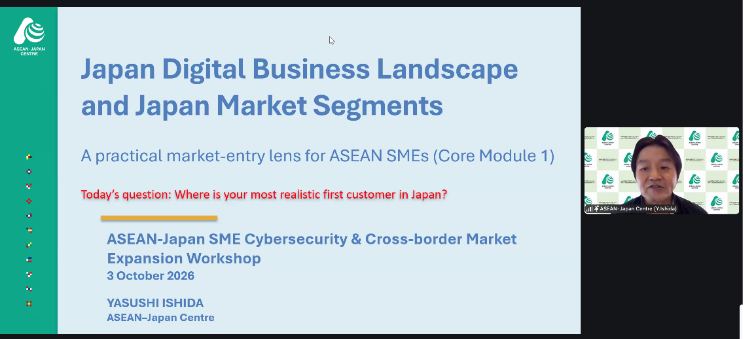
Mr. Yasushi Ishida, Deputy to the Directors of Programme Operations of ASEAN-Japan Centre, encouraged participants to start with a practical question: “Who is your most realistic first customer in Japan?”. He stressed that SMEs should identify a customer with a clear need whom they can realistically reach and serve.
Participants explored different market opportunities, including B2C e-commerce, B2B products and services, digital services, and emerging technologies. Particular attention was given to distinguishing the target customer from the route to market, as SMEs may enter Japan through importers, distributors, digital platforms, system integrators, or other local partners.
Participants were encouraged to assess potential opportunities based on product fit, business capability, price and value, and existing experience, and to consider whether a potential customer has a clear need, is realistically reachable, and offers an opportunity for a small-scale pilot or initial transaction.
Developing a focused Go-to-Market (GTM) strategy
Building on the market-entry and cybersecurity discussions, Dr. Katrina Navallo, Head of Research and Policy Advocacy atof ASEAN-Japan Centre guided participants through a practical GTM framework for Japan.
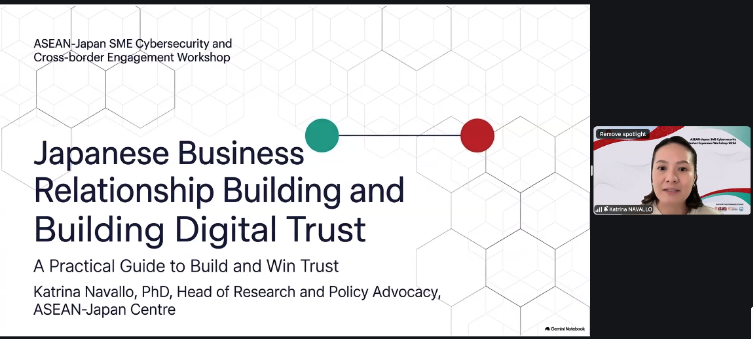
She emphasized that SMEs entering a complex market such as Japan should avoid trying to target too many customers or channels at once. Instead, participants were encouraged to start with one clearly defined market and customer segment.
Participants discussed different routes to market, including direct online sales, Japanese platforms and distributors, and partnerships with Japanese businesses. For many SMEs, particularly those operating in B2B markets, working with an established local partner may offer a more practical entry point.
Strengthening cybersecurity and digital trust
The following session, led by Mr. Axl Nakata, Consulting Manager atof Kiantara, focused on practical cybersecurity readiness for SMEs.
Using real-world cybersecurity incidents and findings from the programme’s SME readiness survey, he demonstrated how weaknesses in areas such as account security, data management, and incident preparedness can affect not only business operations but also the confidence of prospective partners.
The session introduced several basic measures that SMEs can implement even with limited budgets, including multi-factor authentication (MFA), stronger password management, data mapping, access control, backups, and a simple incident-response plan.
Participants were further reminded to avoid overclaiming their cybersecurity capabilities. Where measures are still being developed, businesses should communicate this transparently and indicate how and when improvements will be completed.
Applying the learning through the GTM Mini Canvas
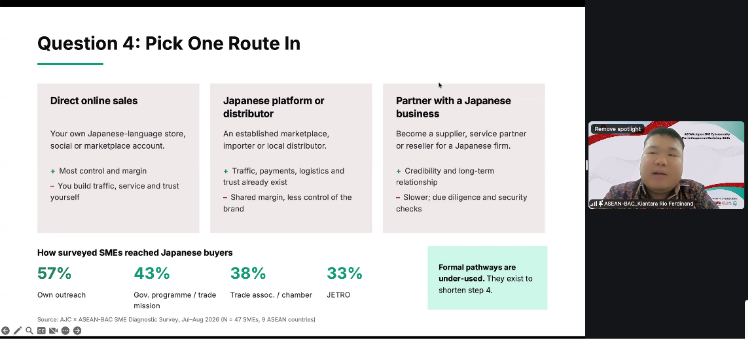
Mr. Rio Kiantara, Head of Research and Partnership atof ASEAN Business Advisory Council, guided participants through a practical Go-to-Market (GTM) framework to help translate the session’s market insights into an actionable Japan market-entry strategy. He stressed that SMEs should develop a focused, Japan-specific market-entry strategy, rather than relying on a broad or generic international approach.
Through the GTM Mini Canvas exercise, participants applied the framework to their own businesses and discussed potential market-entry approaches. The exercise will also contribute to the participants’ final pitch decks, where they will further refine their proposed strategies for entering or expanding in the Japanese market.
Moving from opportunity to trusted market entry
Throughout Module 1, participants were encouraged to approach Japan market entry progressively: identify a realistic first customer, understand the customer’s needs, select an appropriate route to market, demonstrate cybersecurity and business readiness, and build trust through consistent engagement.
The session provided participating SMEs with a practical foundation for refining their market-entry strategies as they continue through Phase 1 of the ASEAN-Japan SME Cybersecurity and Cross-border Market Expansion Workshop.