

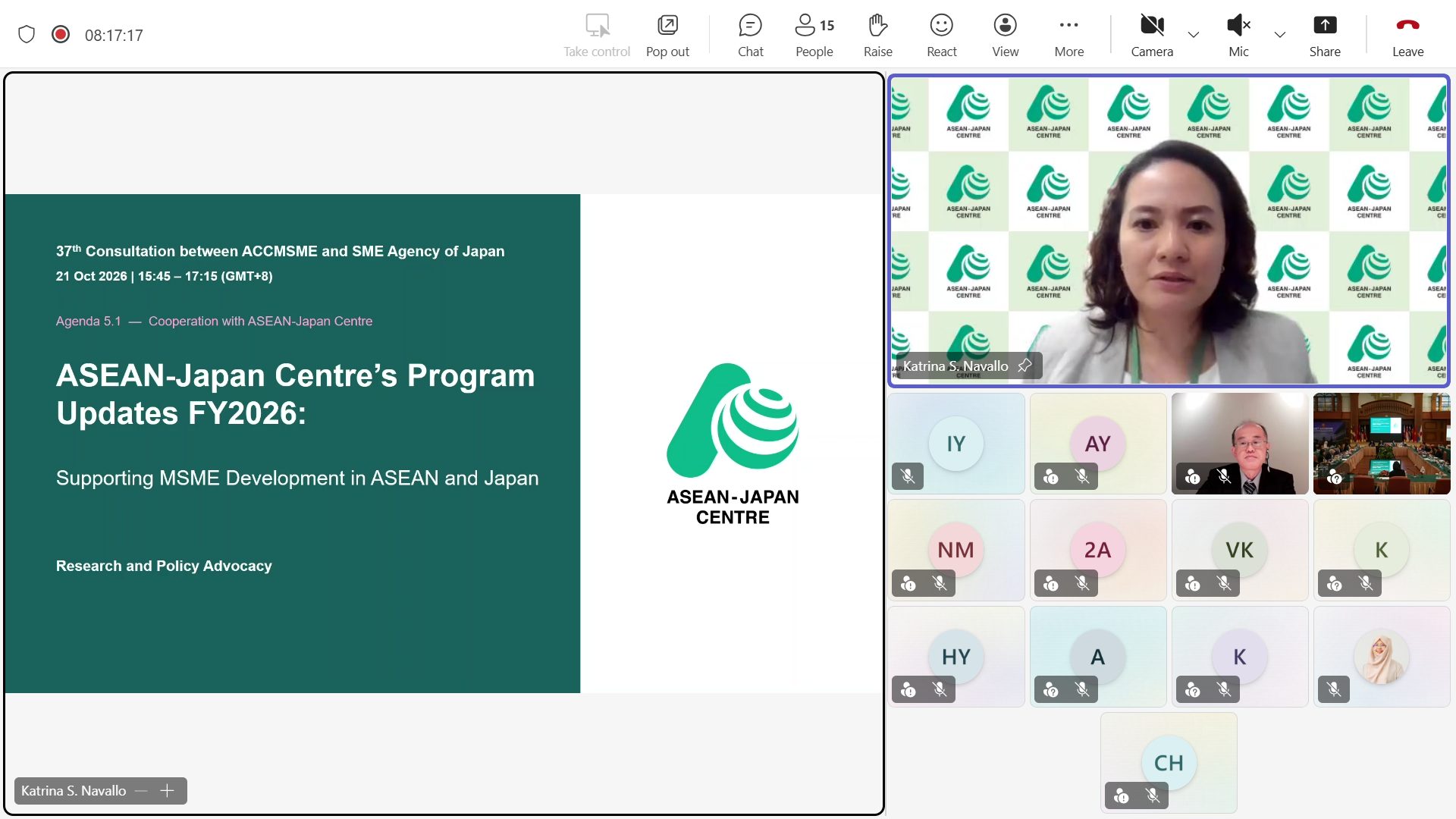
The ASEAN-Japan Centre (AJC) participated in the 37th Joint Consultation between the ASEAN Coordinating Committee on Micro, Small and Medium Enterprises (ACCMSME) and the SME Agency of Japan, held on 21 October 2026 (hybrid) in Bandar Seri Begawan, Brunei Darussalam.
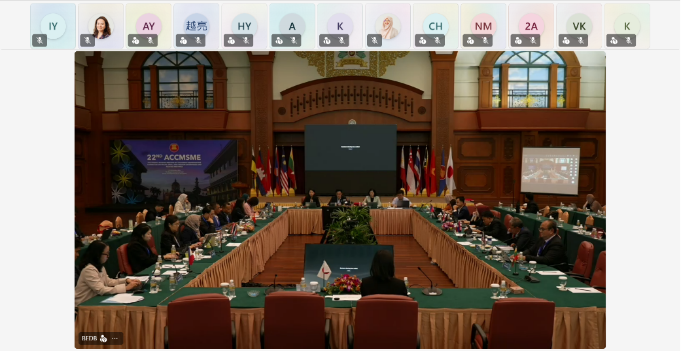
Figure 1 The 37th Joint Consultation Meeting between ACCMSME and SME Agency of Japan convened in a hybrid format in Brunei Darussalam
The consultation provides an opportunity for ASEAN Member States and Japan to exchange updates on MSME development policies, review ongoing cooperation initiatives, and explore opportunities to strengthen MSME competitiveness, resilience, and internationalization.
During the meeting, AJC presented updates and findings from three of its MSME development initiatives: ImpactLink 2026, the Cybersecurity Workshop for ASEAN SMEs, and the FTA Utilization Seminar in Indonesia. The presentation highlighted persistent challenges faced by ASEAN enterprises in accessing finance, strengthening investment and cybersecurity readiness, and navigating the Japanese market.
ImpactLink 2026: Strengthening Impact and Readiness to Access New Markets for Women-led Social Enterprises in ASEAN
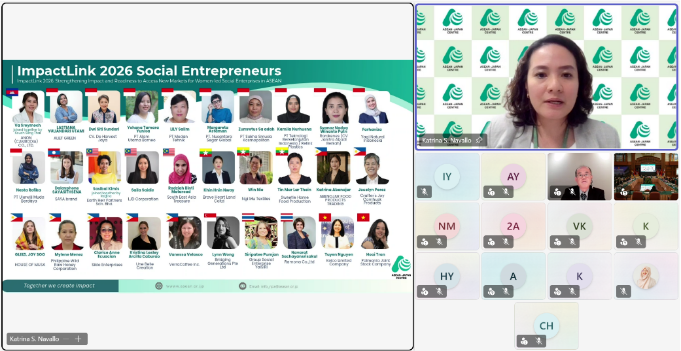
Figure 2 Dr. Katrina Navallo reporting the progress of ImpactLink programme
AJC reported progress under its ImpactLink 2026 programme, which selected 30 women-led enterprises from nine ASEAN Member States out of 70 applicants. Between August and September 2026, the programme conducted four full-day workshops covering business development and culminating in a session focused on entering the Japanese market. Participants also had opportunities to engage directly with Japanese enterprises and successful Indonesian businesses that have entered the Japanese market, gaining practical insights into business development and market entry.
AJC also presented findings from two recently published reports examining barriers to business growth and investment readiness among women-led social enterprises. The first report, Navigating Barriers to Growth: Challenges Facing Women-led Social Enterprises in ASEAN and Japan, identified four major challenges: limited access to finance, gaps in digitalization, challenges related to sustainability, and gender-related and cultural barriers. Meanwhile, the second report, Building Investment Readiness and Ecosystem Connectivity for Women-Led Social Enterprises in ASEAN and Japan, based on a cohort of 33 enterprises of the ImpactLink 2025, highlighted that the financing challenge extends beyond access to funding, as many enterprises also face gaps in their readiness to attract and secure investment.
These findings underscored the importance of providing more targeted support to women-led enterprises through blended-finance mechanisms, small-ticket guarantee schemes, cybersecurity guidance, knowledge-exchange dialogues, and expanded mentorship opportunities. Building on these efforts, AJC has selected ten promising enterprises for one-on-one tailored coaching sessions from October in preparation for a pitching session planned in Tokyo in February 2027.
ASEAN-Japan SME Cybersecurity and Cross-border Market Expansion Workshop: Addressing Digital Readiness and Japan-Market Entry Challenges
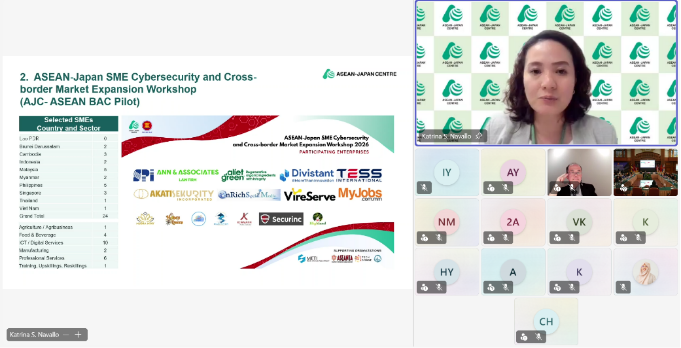
Figure 2 Dr. Katrina Navallo reporting the progress of ASEAN-Japan SME Cybersecurity and Cross-border Market Expansion Workshop programme
AJC also presented preliminary findings from its Cybersecurity Workshop programme, which selected 24 enterprises from 46 applicants across nine ASEAN Member States. The programme aims to strengthen ASEAN SMEs’ cybersecurity capabilities and readiness to establish secure and trusted business relationships with Japanese partners.
The findings identified four major challenges faced by participating SMEs: limited understanding of the Japanese market, difficulties accessing Japanese business networks and potential partners, language barriers, and challenges in understanding regulatory requirements.
The assessment further revealed significant gaps in cybersecurity preparedness and Japan-market readiness. Only approximately 30% of participating enterprises had cybersecurity governance or business continuity plans, while around 28% had previously engaged with Japanese business partners or clients. Furthermore, only approximately 11% reported full awareness of Japan’s Act on the Protection of Personal Information (APPI), indicating a substantial information gap concerning data protection and regulatory compliance. Differences in cybersecurity incident-reporting timelines across jurisdictions were also highlighted, demonstrating the complexities SMEs may encounter when conducting cross-border digital business activities.
These findings underscored the importance of strengthening cybersecurity capabilities alongside practical support for Japan-market entry, particularly through improved access to market information, regulatory guidance, and business networking opportunities. Building on the initial phase of the programme, AJC plans to select ten enterprises for further mentoring in the second phase, supporting their readiness to engage with Japanese business partners and expand cross-border business opportunities.
FTA Utilization Seminar: Improving Access to Information for Indonesia–Japan Trade
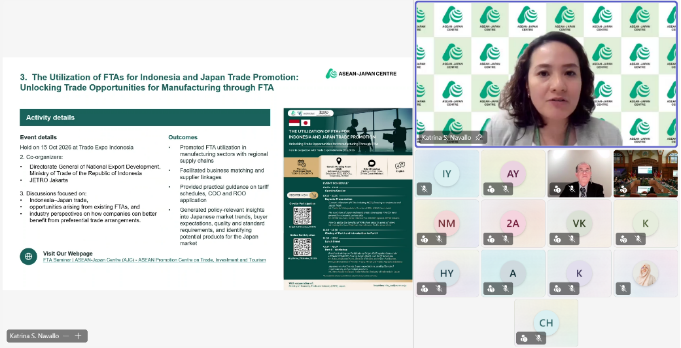
Figure 3 Dr. Katrina Navallo reporting the findings on FTA Seminar in Indonesia (15 October 2026)
AJC also shared the outcomes of the FTA Utilization Seminar in Indonesia, held on 15 October 2026 during Trade Expo Indonesia, co-organized with Ministry of Trade of the Republic of Indonesia (Directorate General of National Export Development) and JETRO Jakarta and with the support of Ministry of Economy, Trade and Industry (METI) Japan. The seminar focused on promoting trade opportunities between Indonesia and Japan through the effective utilization of existing Free Trade Agreements (FTAs).
A key challenge highlighted during the seminar was the lack of accessible and practical information on which FTAs are most appropriate for SMEs seeking to enter the Japanese market. Despite the availability of preferential trade arrangements, many SMEs face difficulties identifying the most suitable agreements and understanding how to utilize them effectively.
AJC therefore emphasized the importance of strengthening information dissemination and providing practical guidance on FTA utilization to help SMEs better understand available trade opportunities, benefit from existing agreements, and facilitate their entry into the Japanese market.
Taken together, the findings from AJC’s three initiatives highlighted several interconnected challenges facing ASEAN MSMEs, particularly in access to finance and investment readiness, digital and cybersecurity capabilities, understanding of Japanese market requirements, and access to relevant information and business networks. These findings underscored the importance of continued capacity-building, targeted mentorship, and improved access to practical information and business opportunities to strengthen ASEAN MSMEs’ competitiveness and readiness to engage with the Japanese market.


