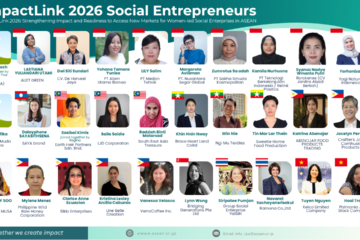
The ASEAN-Japan Centre, in partnership with Proficeo Consultants Sdn Bhd, conducted ImpactLink2026 Session 3: AI-Assisted Communication, Pitch Deck & Narratives on 29 August 2026. Twenty-seven (27) women-led social enterprises from 8 ASEAN Member States joined the third session of the programme, in which the Japan-linked market segmentation and pathway identified in Session 1 and the impact story built in Session 2 were brought together into a pitch deck to strengthen a narrative for each enterprise.
The session began by drawing the programme’s three parts together: the realistic Japan-linked market pathway each enterprise had identified, the impact story and supporting evidence each had developed, and the pitch deck they would now need to construct from both. Participants were reminded that a presentation is a living document to be revisited and updated rather than a one-off deliverable.
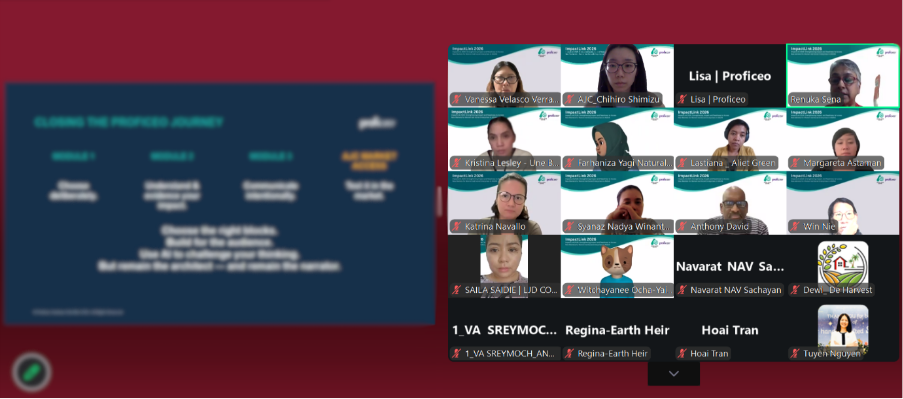
Using AI Tools in Impact Storytelling
In the morning session, the participants learnt the practical use of widely available generative AI tools as an assistant to communication work.
Participants learned that the quality of what they receive depends almost entirely on the quality of the instruction they give, the so-called ‘prompt’. Rather than a single-line request, an effective prompt describes the enterprise and its situation, names the audience the output is intended for, specifies the format and length required, and sets the tone. The session also introduced the distinction between an enterprise’s visual identity, its voice and its tone, how a brand looks, how it sounds, and how that sound shifts with the audience.
Participants were then introduced to a research and content AI tool and they assembled a knowledge base for their enterprise and used it to produce and refine communication material. Throughout, the emphasis remained on preserving verified facts, refusing invented statistics or testimonials, and clearly labelling anything that remained an assumption. The participants also had a chance to ask questions and obtain hands-on instructions from the facilitator on how to navigate the AI tool to generate the best results.
Challenging Japan-Linked Market Hypotheses Through Different Lenses
The afternoon opened with a reality check on the Japanese market. Two ASEAN-Japan Centre staff members spoke about their lived experience in Japan, giving participants direct access to the perspective of the market they had spent the programme preparing to enter.
Participants had formed a picture of their Japan-linked customer from desk research, from the market work of Session 1 and, with the assistance of AI tools in this session. Hearing authentic voices from the consumers in Japan-linked market itself allowed them to test that picture against reality, to see which of their assumptions held, which did not, and where an AI-generated inference about Japanese customers had quietly filled a gap that only a real voice could correct. It reinforced a caution issued repeatedly during the morning: an AI tool cannot know what a customer thinks, and an assumption about an audience remains an assumption until that audience confirms it.
Articulating Clear Evidence behind the Story and Impact
Participants then presented their work to their peers, each addressing three questions in relation to their own enterprise: primary customer segment, impact narrative, and evidence.
Impact evidence means demonstrable benefit to the people an enterprise exists to serve, expressed in figures wherever possible, not the enterprise’s own commercial achievements, and not certifications held; several participants had been treating the latter as proof of impact. On segmentation, participants were cautioned against grouping distinct populations together and asked to build customer profiles specific enough to act on. Underlying both was a single requirement: a claim advanced to an audience must be supported by data the enterprise actually holds.
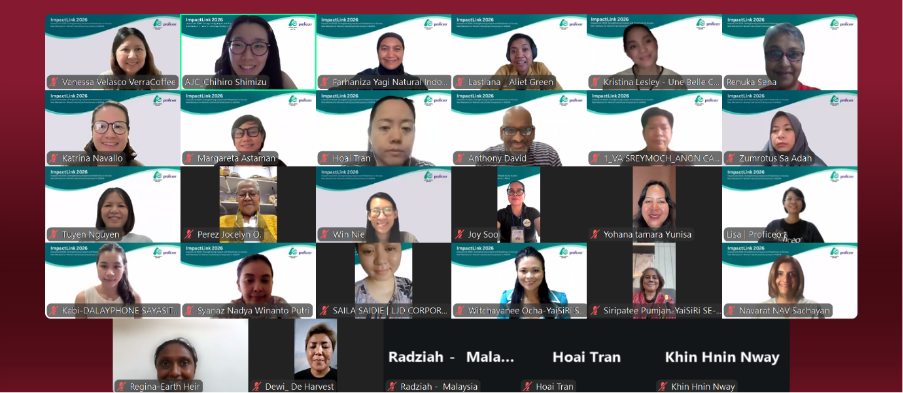
Reflecting on What Has Changed
The session closed with a reflection in which participants looked back across the three workshops and what they had taken from the programme.
“I thought my market intuition was enough – that finding the right product was all it took. Now, I realize it takes a good product, confident storytelling, and clear metrics to approach the market.” (Participant A)
“It changed the way I see impact – from simply measuring what we do to understanding what changes for the people we serve, why that change happens, and how we can prove our contribution to it. ” (Participant B)
“Finally I have a structure to gather impact evidence and a way to tell relevant impact to specific audience.” (Participant C)
Across the three sessions, participants moved from identifying a realistic route into a Japan-linked market, to evidencing the change their enterprises create, to presenting both as a single credible proposition. The participant will move onto the last session of the Phase 1 – Session 4: Japan Market Session to hear from ASEAN-related enterprises which successfully entered Japan-linked market and have been actively engaging with Japanese customers.