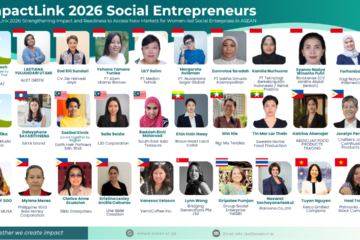
The ASEAN-Japan Centre, in partnership with Proficeo Consultants Sdn Bhd, had conducted ImpactLink2026 Session 2: Storytelling for Impact on 22 August 2026. Twenty-nine (29) women-led social enterprises from 9 ASEAN Member States joined Session 2, bringing their enthusiasm together to answer a question: how does a social enterprise credibly demonstrate the change it creates?
Across a full day of plenary discussion, small-group breakout rooms and individual exercises, participants moved from purpose to proof — articulating why their enterprise exists and the long-term change it seeks, mapping how that change is expected to happen and what has to hold true for it to work using the frameworks provided in the session. The participants were also engaged in discussion actively with their peers, identifying the evidence needed to substantiate it, and shaping the result into a story that can be told to investors, buyers and partners without overstating what the enterprise can prove.
In the beginning, the participants were challenged by the most fundamental yet important question: why the enterprise exists, and what long-term change it is working towards. They were guided to begin from purpose rather than from their products or services, and to consider what would be lost if their organisation stopped existing tomorrow.
Breakout Session 1: Strengthening an Impact Story
Participants moved into small groups to present their structured impact stories based on an impact storytelling framework and to give one another feedback. Following the first breakout exercise, the session moved from narrative structure to the pathway beneath it, introducing the Theory of Change (TOC): how, concretely, the intended change is expected to happen, from resources and activities through to outputs, outcomes and long-term change.
Breakout Session 2: Theory of Change
The second breakout session tested the participants’ understanding of the TOC framework using a case study of a rural agricultural enterprise where they identified the social challenge, beneficiaries, inputs, outputs, outcomes and the long-term impact.
Breakout Session 3: Turning Promise into Proof
If a Theory of Change is the enterprise’s promise, how does anyone know the promise is true and being kept? The participants were taught how to set indicators and means of verification against each claimed outcome, in both qualitative and quantitative terms.
Participants were advised to return continually to their own Theory of Change as the reference point, and to review the framework at least annually rather than treating it as a one-off exercise.
This will allow the enterprise’s promise into the proof of the reliable, measurable, and meaningful pathway. Measuring impact is not because being asked to do so, instead, the enterprises can learn, improve, and make better decisions based on evaluations of impact they made.
Participants learned why evidence alone is insufficient. Numbers demonstrate scale; individual stories demonstrate significance; hence both are required. Participants were introduced to a structured approach for storytelling as a way of making the pathway tangible without departing from what their impact metrics can substantiate.
Who Makes Change Possible?
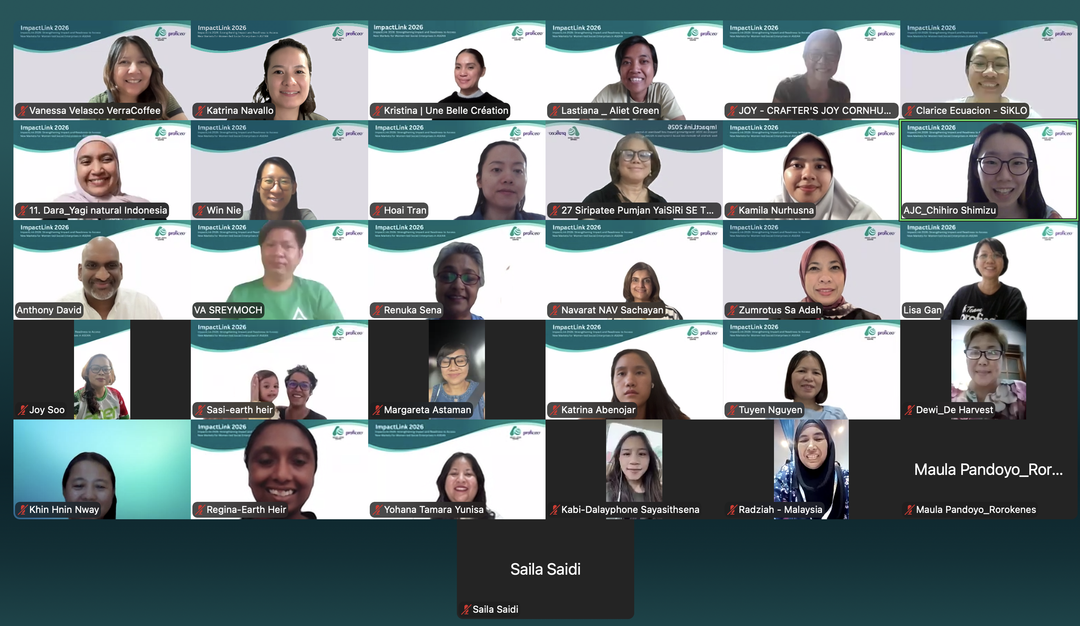
The session closed by drawing the day’s separate pieces into a single narrative. Some elements of an enterprise’s impact story do not change regardless of who are you presenting to; others should be adapted depending on different audience but without changing the truth.
The Session 2 asked participants to move from describing what their enterprises do to demonstrating, credibly and in evidence, the change their enterprises create. The Session 3 will bring learnings from Session 1 & 2 together to learn how to present participants’ business and impact stories effectively.