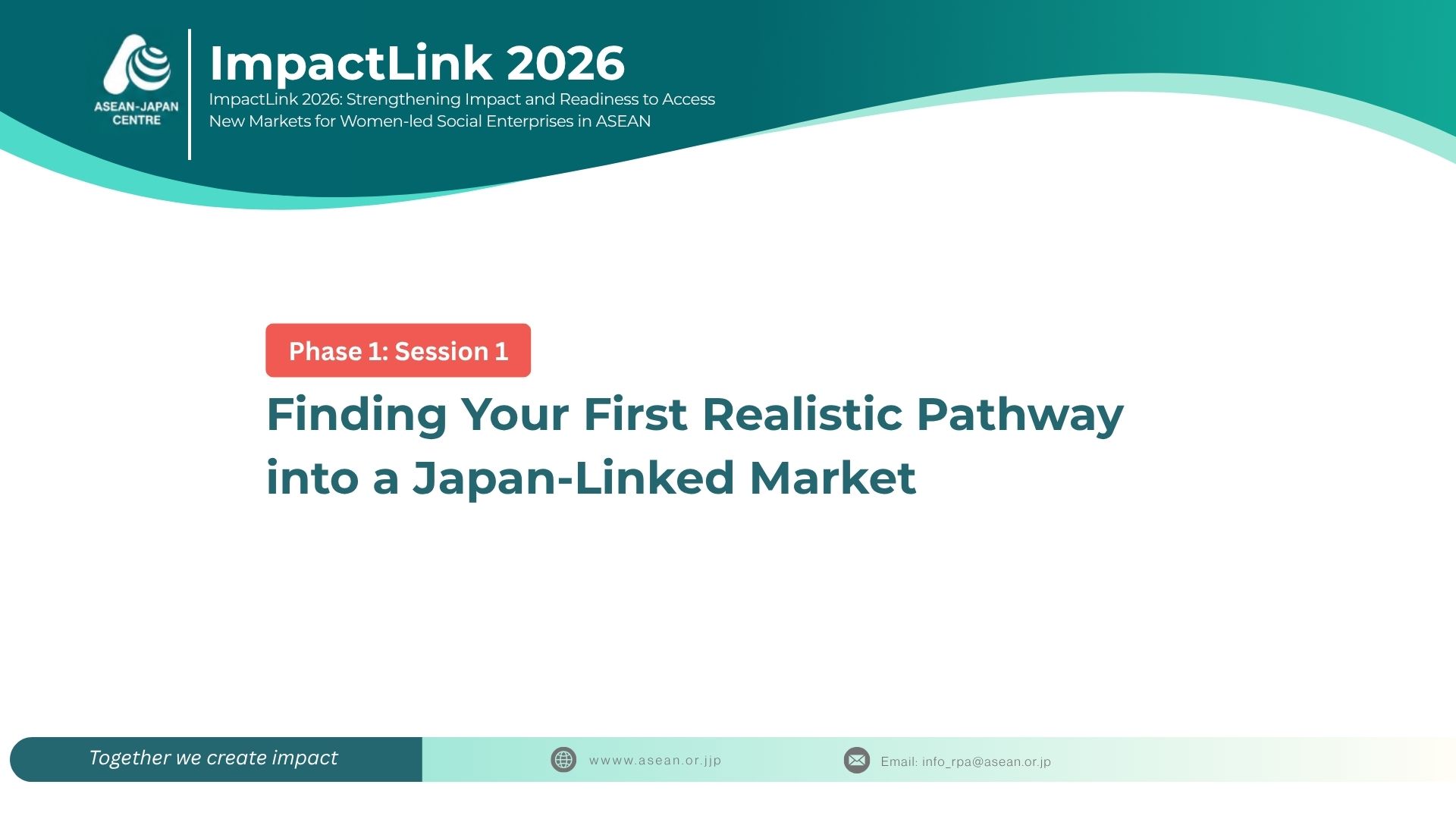
The ASEAN–Japan Centre, together with our implementing partner: Proficeo Consultants Sdn Bhd convened Session 1 of the ImpactLink2026 programme on Saturday, 15 August 2026, the first full workshop bringing together 30 women social entrepreneurs from across nine ASEAN Member States.
The session was built on a deliberately narrow premise. Rather than asking participants how to sell in Japan, it asked them to identify which Japan-linked opportunities were realistic enough to test first.
Widening the definition of the Japanese market
The opening session challenged an assumption that many participants had brought with them — that reaching the Japanese market just means exporting goods and services to Japan. However, the session identified five Japan-linked market segments, each carrying different value signals, different plausible routes and a different level of entry friction.
Participants were asked to choose two opportunities among Japan-linked market segments. Several participants said they had never systematically considered the reasons a Japanese buyer might hesitate to buy from them. After identifying two potential opportunities, the participants also considered illustrative customer cases in order to capture customer profile more clearly.
Breakout Session 1: Market Discovery
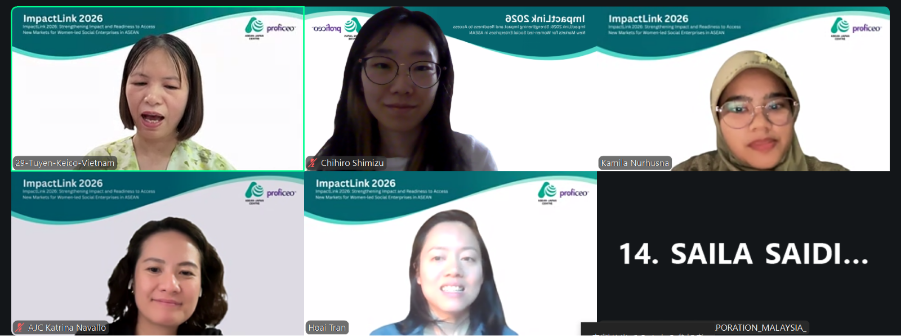
The first breakout session exercise provided an opportunity to the participants to introduce their enterprise, two potential opportunities they chose and one uncertainty, and have discussion among the participants to clarify, challenge and refine.
One of the participants was questioned on how it differentiates itself from lower-cost competitors, and answered with exclusive designs, professional export staff and long-term investment in its local farmers. The other emphasised on buyers who value sustainability are simply a different customer set from volume retailers. The discussion also went into how quality is controlled to export standard, and described working directly with local farmers under specific years of contracts with agreed prices and specifications.
Reporting back in plenary, the six groups converged on a consistent set of concerns. Pricing recurred in almost every group, tied to the difficulty of reconciling handmade production with volume expectations. Food and beverage producers named accredited laboratory testing, packaging and shelf life as their single largest barrier; others said they would need certification to evidence responsible sourcing. Quality and technical standards, logistics and delivery cost, and minimum order quantities appeared across sectors. Underlying all of them was a question several groups asked directly: does the Japanese market recognise and pay for the social and environmental value these enterprises create? The answer the groups arrived at themselves was that verifiable storytelling — being able to show how much value returns to artisans and communities — is what converts that value into trust.
One reflection was echoed by several groups. Most of the participants had joined this workshop believing their difficulties were particular to their own enterprise, and wrapped up the morning session aware that they were shared across the region and they are not alone.
From opportunity to pathway
The afternoon session narrowed from segments to decisions. Participants selected products rather than catalogued them, testing each for customer appeal, reliable delivery and the minimum adaptation required, then scanned several market pathways.
The readiness session made the central point of the day. Rather than asking “are we ready,” participants were directed to verify which route is their own and right way to enter the market. Several participants found their preferred channel changed once the gaps were visible.
Breakout Session 2: Market Selection
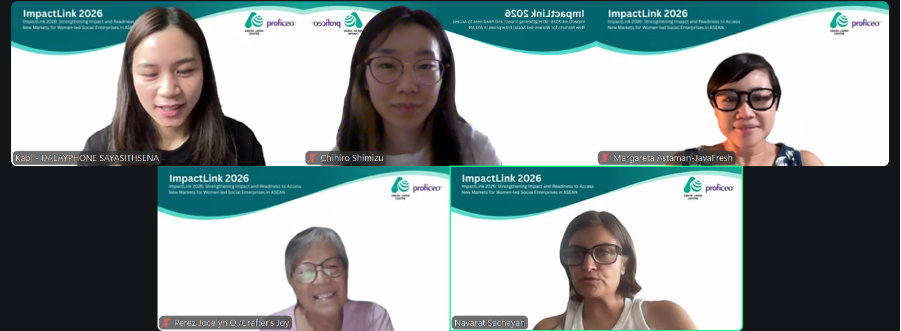
In breakout session 2, each participant presented one selected market pathway and named the assumption she most wanted challenged, while peers provided feedback to each other — stress-testing whether the customer will care, how they will discover and trust the product, what capability gap could stop the pathway, and what evidence would raise confidence. The gaps named here were more concrete than those raised in the morning: Japanese functional and quality standard, export documentation, the cost and complexity of establishing a presence in Japan, and the need for evidence of sustainable sourcing.
Turning assumptions into evidence
The closing session reframed the day’s output as hypotheses rather than conclusions. Proficeo emphasised, desk research is not sufficient on its own; speaking directly to customers is the strongest form of early validation, whether of product, price, design or colour.
Each entrepreneur left with a validation plan for both opportunities — the question she needs to answer, how she will validate it, who or what can provide the evidence. The Session 2 will be covering how to build and convey effective impact stories and narratives that the participants would use to validate their social impact.