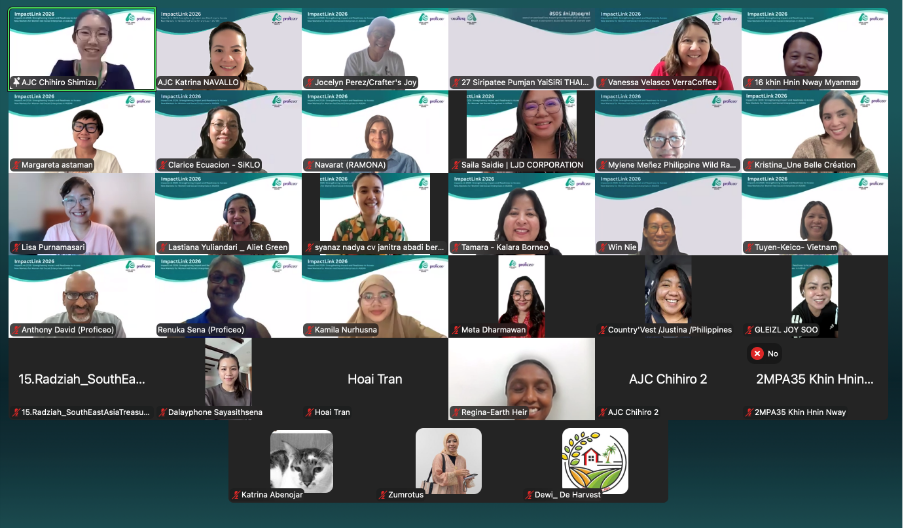
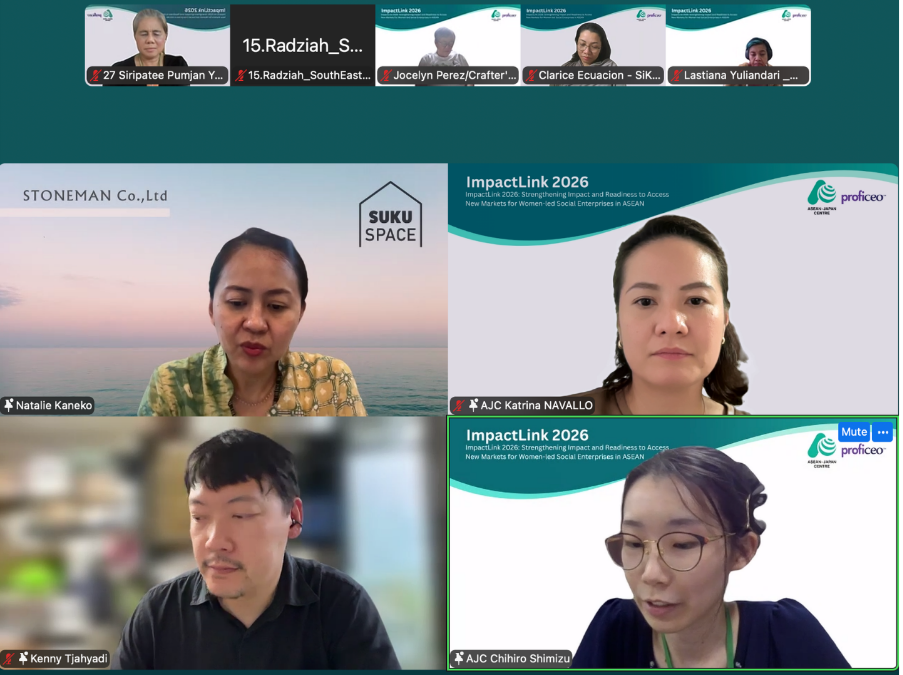
On Saturday, 5 September 2026, the ASEAN-Japan Centre (AJC), together with implementing partner Proficeo Consultants Sdn Bhd, held Session 4: Japan market Understanding of the ImpactLink 2026 programme. Bringing together 27 women social entrepreneurs from across eight (8) ASEAN Member States, the session marked a pivotal transition in Phase 1—moving participants from internal impact articulation toward evaluating concrete, realistic market entry pathways in Japan. Tailored specifically for small-batch producers, the full-day online workshop provided practical market intelligence, buyer selection criteria, category-specific entry strategies, and real-world case studies presented directly from the speakers’ operational slide decks.
Unlocking Japanese Market Opportunities and Consumer Dynamics
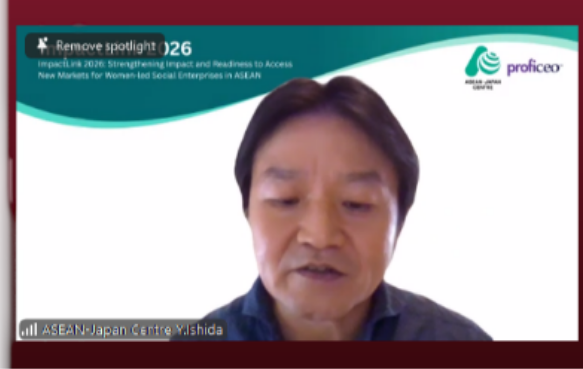
The morning plenary opened with a keynote presentation by Mr. Yasushi Ishida, Deputy to the Director of Programme Operations at the ASEAN-Japan Centre, titled “Japanese Market Opportunities: From ‘exporting a product’ to finding a Japanese market fit”. Mr. Ishida emphasized that while Japan is an attractive market, it is not a “mass market first” story, requiring founders to adopt a narrow entry logic focused on specific customer benefits rather than general market size. He introduced a three-step action framework: reading the market, translating impact into consumer value, and choosing a small first move.
Key presentation insights included:
- Demographic Realities & Packaging Needs: Japan’s aging and shrinking population, combined with compact single-person households, drives consumer demand toward wellness, convenience, smaller portion sizes, easy-to-use design, and compact or foldable packaging.
- The Opportunity Equation: Value is generated when product benefits, consumer trust, and social meaning align. Impact must reinforce core product value rather than replace it.
- Frictionless Localization: True localization is not “becoming Japanese”—it means preserving authentic origin while removing friction across product size, formulation, packaging, Japanese labeling, price, and service.
- Digital Channels & Regional Choices: Citing Ministry of Economy, Trade and Industry (METI) survey data showing Japan’s B2C e-commerce market reaching ¥26.1 trillion, Mr. Ishida noted that digital platforms lower entry barriers but not trust barriers. He guided founders to select regional and channel combinations matching their operational scale. Sectoral lenses were illustrated using real enterprise models.
Decoding What Japanese Buyers Look for in Overseas Suppliers
Building on market dynamics, Mr. Yu Mizui, Founder & CEO of Cocowell Corporation, presented “What Japanese Companies Look for in Long-Term Partners”. Founded in 2004 in Osaka, Cocowell manufactures, imports, and distributes organic coconut products—ranging from dietary oils and Medium Chain Triglycerides (MCT) oil to snacks, cosmetics, gluten-free bakery goods (“Cocowell Lab”), and coconut ice cream (“Sari Sari Store”). Mr. Mizui shared his founding story of studying in the Philippines, visiting the Smokey Mountain garbage dump in Tondo, Manila, and realizing that rural poverty drives urban migration—inspiring him to establish fair-trade coconut supply chains. Today, Cocowell supplies major retail networks across Japan.
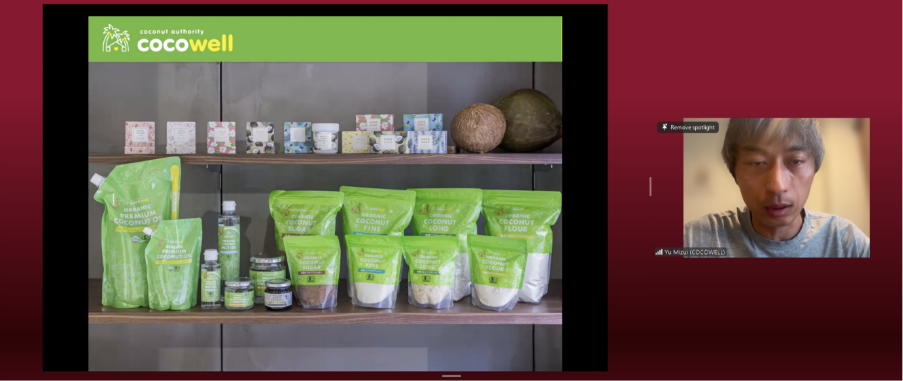
Drawing from his extensive trade experience, Mr. Mizui outlined core principles for overseas social enterprises:
- Quality vs. Consistency: Japanese buyers demand consistent quality across every shipment over time.
- Product Value Over Purpose: Purpose opens hearts, but the product must deliver real value.
- The Repeat Order Metric: The first order shows initial interest, but repeat orders prove real market fit.
- Equipping Internal Champions: Founders must provide clear answers regarding product specifications, customer fit, price structures, and verifiable impact so buyers can easily justify the product internally.
- Supplier vs. Partner: A supplier merely delivers what is ordered, whereas a true partner thinks about the business together—sharing problems early, providing honest feedback, and suggesting improvements.
Facilitated Expert Q&A: Agri, Food, Beverage, and Wellness
In the first sector-focused session, participants in food, agriculture, and wellness engaged in a Q&A session facilitated by Mr. Ishida and Mr. Mizui.
Summarized Q&A themes included:
- Batch Consistency & Shelf-Life Verification: Managing quality controls, shelf-life testing, and handling protocols for specialty food and natural ingredients.
- Regulatory Compliance: Meeting mandatory Japanese food safety regulations, ingredient claim disclosures, and Japanese-language labeling requirements.
- Pricing & Channel Margins: Structuring export pricing while working backward from Japanese retail prices and distributor channel margins.
Case Study 1: Indonesian Café & Food Ventures in Japan
In the afternoon case study segment, Mr. Kenny Tjahyadi, Founder & CEO of Kopikalyan Tokyo, delivered a presentation titled “Indonesian Cafe in Japan: What I learned bringing coffee (and products) here”.

Mr. Tjahyadi detailed Kopikalyan’s expansion from Jakarta into Japan through three distinct business units (“Three Doors”):
- Kopikalyan Tokyo: Established in Harajuku (Jingumae) in late 2020 as the brand’s first overseas store, operating as a “living showroom” and a Muslim-friendly space with a dedicated prayer room.
- SUKA Kuramae: Opened in 2025 near Asakusa featuring a 1F Toko (grocery/convenience) and 2F Warung (Indonesian eatery). Serving both Japanese consumers and Japan’s ~231,000 Indonesian residents. SUKA serves as an SME test market for packaging, labeling, cooking instructions, and rules.
- THREEUNITED (House of Beans): Managing green coffee bean imports, roasting, consulting, and events.
Mr. Tjahyadi highlighted that market entry requires small-volume, high-quality specialty coffee paired with transparent farm origin stories. He stressed that the true work of market entry is “translation”—adapting taste profiles, packaging, labels, and usage contexts so products seamlessly integrate into Japanese daily lives rather than being treated as “ethnic souvenirs”.
Case Study 2: Curating Handicrafts, Bags, and Textiles from Indonesia
Ms. Natalie Kaneko, CEO of SUKU SPACE and Stoneman Co., Ltd., presented “Indonesian Handicrafts, Bags and Textiles Entering the Japanese Market”. SUKU SPACE connects Indonesia and Japan through its Indonesia Business Division (market entry, product development, partnerships) and Media Division (leveraging fashion-magazine editorial expertise to communicate brand value), supported by Stoneman Co., Ltd.’s Shibuya Café & Showroom.
Ms. Kaneko shared examples of supported brands and retail experiences across department store pop-ups, ID BAZAAR, and Expo 2025 Osaka co-creation projects.
She outlined a practical 3-step framework for artisanal lifestyle brands:
- Clarify Brand Story: Define why the brand started, who makes the products, local materials/techniques used, and the core message.
- Select Sales Channels: Evaluate five distinct routes based on scale—Events & markets, Small specialty shops, Major select shops, Department stores, and Japanese brand OEM supply.
- Move to Co-Creation: “Do not only sell what you make — co-create what the Japanese market needs.” Success relies on modifying materials, adapting colors to seasonal palettes, modifying internal specifications, expanding sizes/uses, and upholding strict inspection and labeling standards.
Facilitated Expert Q&A: Handicrafts, Textiles, Bags, and Coffee
The second interactive session brought together participants in handicrafts, textiles, home decor, and coffee for feedback from Mr. Tjahyadi and Ms. Kaneko.
Summarized Q&A themes included:
- Managing Handcrafted Variations: Upholding strict finishing, weight, size, and packaging standards to compete with Japanese craft traditions (monozukuri).
- Material Declarations & Compliance: Meeting Japanese textile labeling regulations, care instructions, and trademark/design protections.
- Co-Creation Partnerships: Developing collaborative seasonal product lines and adapting specifications directly with Japanese retail buyers.
Turning Insights into Action and Next Steps
The Japan Market Session concluded by reinforcing that cross-border expansion is an ongoing process of testing hypotheses, gathering buyer feedback, and refining product-market fit.
Following Phase 1, selected enterprises will advance to Phase 2 for tailored one-on-one coaching on product positioning and pitch refinement. The programme will culminate in a capstone pitching showcase planned in February 2027, where selected founders will present directly to Japanese and ASEAN buyers, investors, and ecosystem partners.