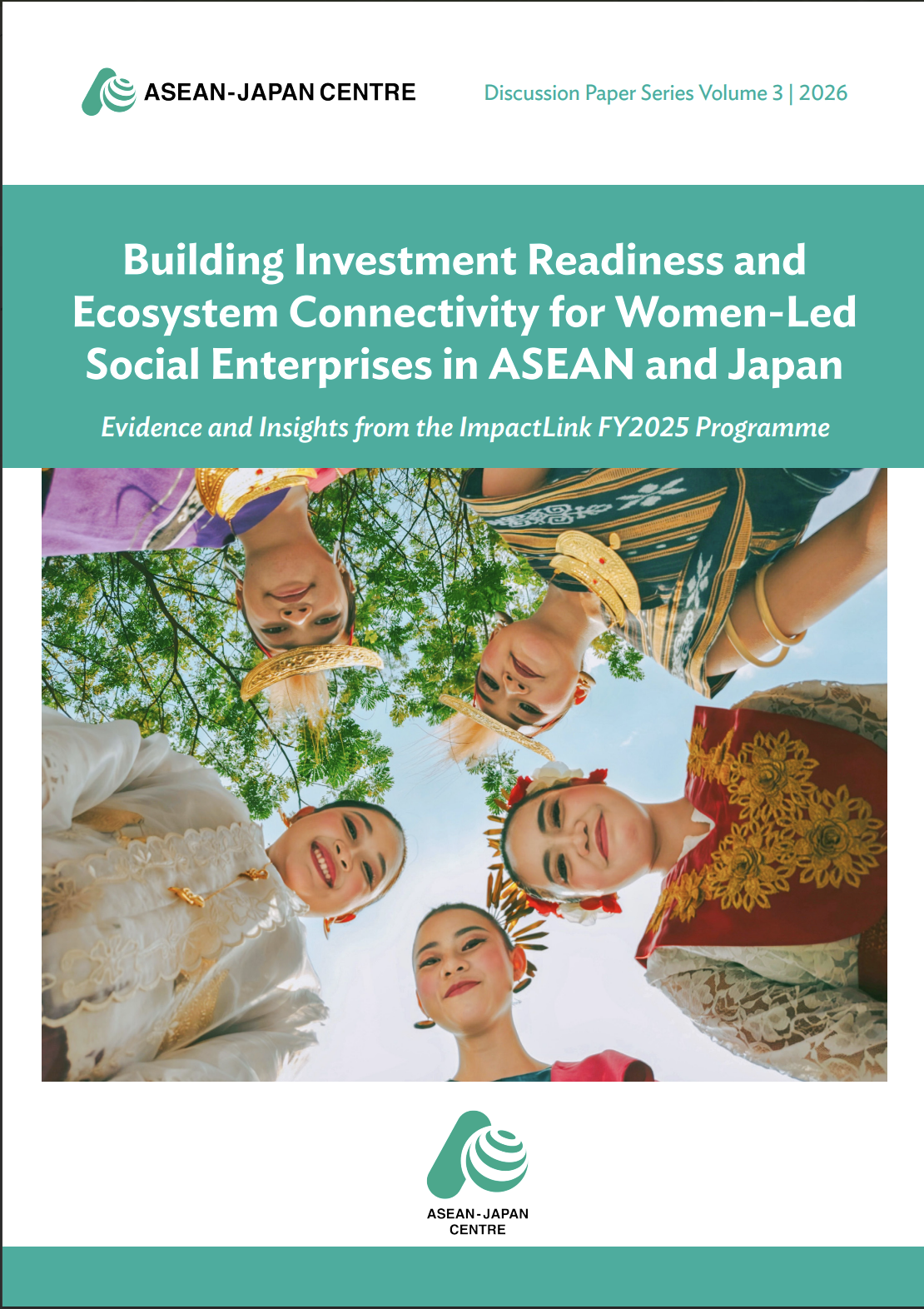
The ASEAN-Japan Centre has published Building Investment Readiness and Ecosystem Connectivity for Women-Led Social Enterprises in ASEAN and Japan: Evidence and Insights from the ImpactLink FY2025 Programme. This is Volume 3 of the Centre’s Discussion Paper Series (2026), co-authored by Preechaya Kittipaisalsilpa, PhD, and Katrina Navallo, PhD.
The paper draws on evidence from ImpactLink: ASEAN-Japan Social Entrepreneurs Hub for Sustainable Innovation. The programme ran from June 2025 to February 2026 and combined online workshops, tailored coaching, mentorship and ecosystem engagement. It received 189 applications from ten ASEAN Member States and Japan. Thirty-three enterprises joined the workshop phase, and 15 advanced to one-on-one coaching.
What the report finds
The financing gap is a readiness gap in disguise. Coaching diagnostics showed that the most pressing barrier was often not a lack of funders. Many enterprises lacked the financial systems, business clarity and funder-facing documentation needed to engage capital providers.
The report presents five key findings:
- Investment readiness is a continuum. Enterprises varied widely in maturity, financial systems, impact measurement and fundraising experience. Uniform training models are not enough, and support needs to be differentiated by stage.
- Stage-appropriate pathways matter more than capital volume. For many enterprises, grants, CSR partnerships, pilot funding and institutional collaboration were more realistic near-term options than equity or commercial loans.
- Financing constraints often mask operational gaps. Unclear business models, weak financial management and limited market positioning frequently stood behind the difficulty of accessing capital.
- Aligned narratives build investor confidence. Most enterprises could explain their social mission clearly. Fewer could link impact, business model and financial need into one coherent case for funders.
- Financial readiness is the biggest constraint. After coaching, readiness to begin capital-raising scored lowest of all dimensions assessed, at 2.64 out of 5. Impact goals and outcomes scored highest, at 4.64.
Early signals of progress
- Participants’ average confidence and understanding scores rose from 3.22 to 4.38 out of 5 after the workshop phase, a gain of 36%.
- Eleven enterprises completed coaching and produced executive summaries, pitch decks, funding strategies and data-room frameworks.
- By the end of the programme, four enterprises had secured funding or financing support, at least seven had active fundraising efforts underway, 15 strategic partnerships had been initiated and one pilot programme had launched.
The authors stress that these are early signals rather than evidence of long-term impact. The coaching cohort was small and self-selected, and the data mainly reflect experiences in ASEAN.
Beyond financing: an ecosystem approach
The report identifies five areas of ecosystem support that matter as much as financing itself: knowledge support, mentorship, funding access, networking opportunities, and skilled and pro-bono expertise.
It then outlines four pillars for future ASEAN-Japan cooperation:
- Strengthen financial and non-financial capabilities, including readiness diagnostics, bookkeeping and financial modelling support, and impact articulation.
- Expand stage-appropriate financing pathways, such as blended finance, CSR enterprise-matching and digital financial services.
- Build a durable ASEAN-Japan ecosystem platform linking corporate partners, mentors and digital tools.
- Generate evidence for regional policy learning through practical toolkits and wider outreach to women social entrepreneurs.
“Investing in women entrepreneurs is an investment in the future prosperity, resilience and inclusiveness of the region.”
— Dr. Kunihiko Hirabayashi, Secretary General, ASEAN-Japan Centre
Read the report
The paper is intended for policymakers, development partners, investors, ecosystem builders and entrepreneurs working to advance women’s entrepreneurship and strengthen ASEAN-Japan cooperation for a more inclusive and sustainable future.
Download the full report: Building Investment Readiness and Ecosystem Connectivity for Women-Led Social Enterprises in ASEAN and Japan: Evidence and Insights from the ImpactLink FY2025 Programme
Disclaimer: The views expressed in the publication are those of the authors and do not necessarily represent the views of the ASEAN-Japan Centre, its governing bodies, member governments or partner organizations.