

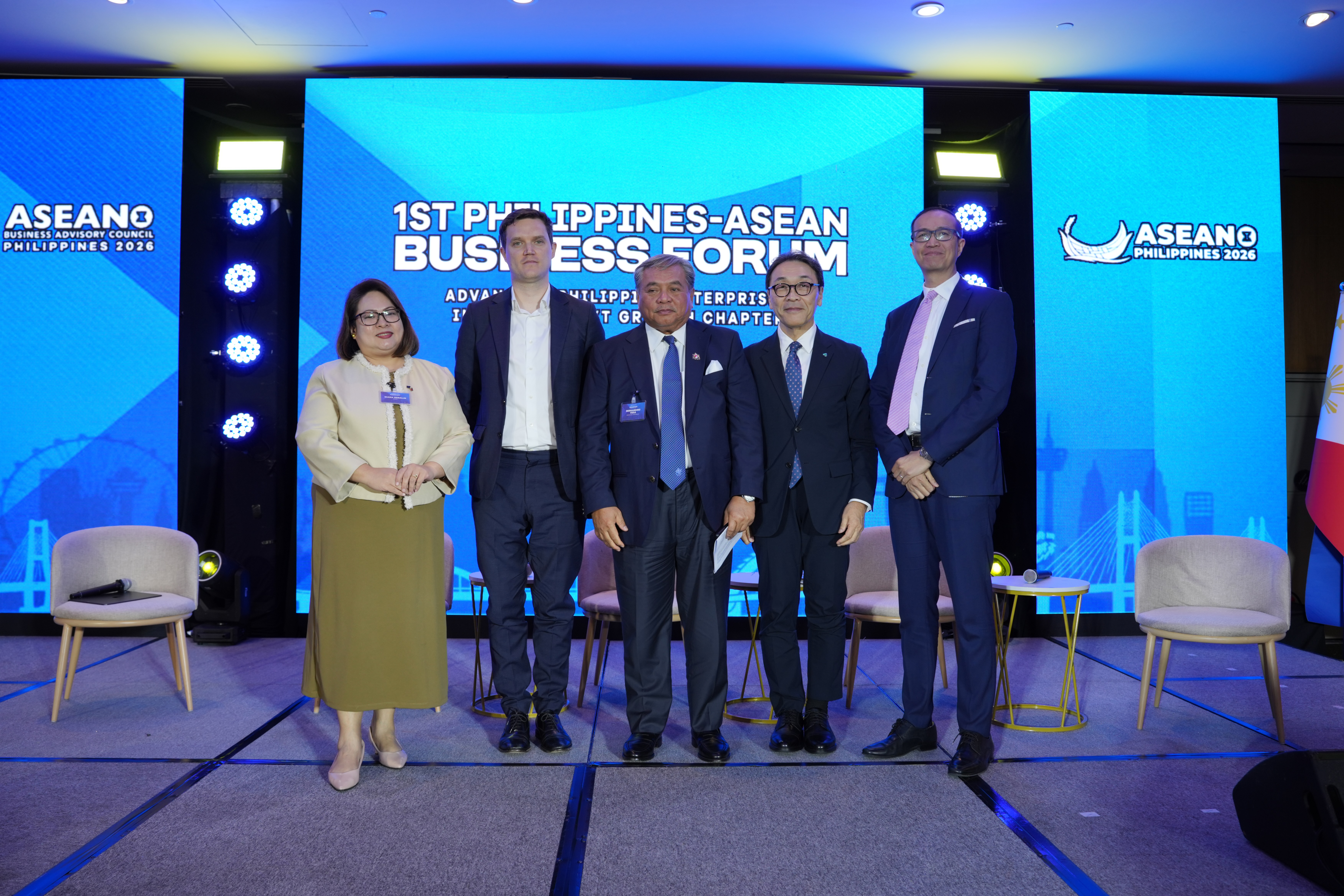
The ASEAN-Japan Centre (AJC) supported the 1st Philippines-ASEAN Business Forum (PABF), hosted by ASEAN-BAC Philippines on 19 September 2026 at the Citadines Bay City Ballroom under the theme “Advancing Philippine Enterprises in ASEAN’s Next Growth Chapter.” Convened as part of the 58th ASEAN Economic Ministers’ (AEM) Meeting and Related Meetings, the Forum drew ASEAN-BAC council members, the EU-ASEAN and US-ASEAN Business Councils, and leadership from Japan’s JETRO and the Economic Research Institute for ASEAN and East Asia (ERIA) — underscoring the depth of the economic ties linking Japan, the Philippines and the wider ASEAN region.
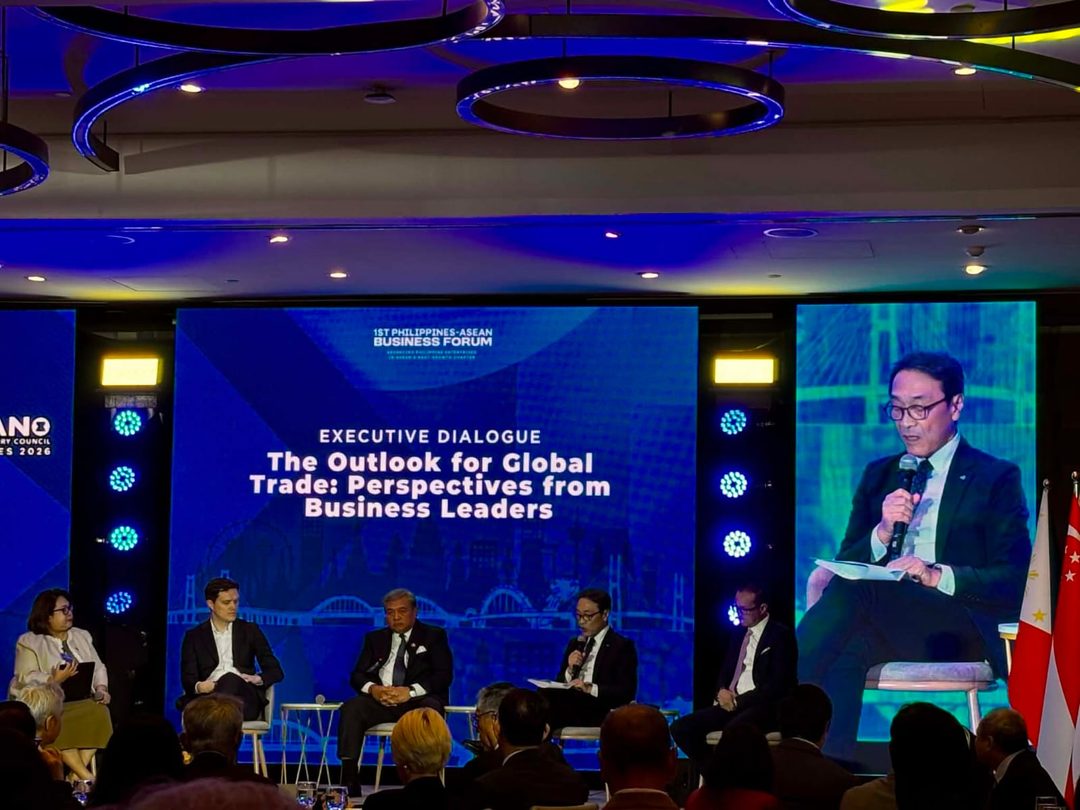
As the only intergovernmental organisation established jointly by Japan and the ten ASEAN Member States, AJC’s presence at PABF reflects its role as a bridge between Japanese and ASEAN business communities. AJC’s Secretary-General, Mr. Kunihiko Chris Hirabayashi, took part as a reactor and panellist in the Forum’s opening Executive Dialogue, “The Outlook for Global Trade: Perspectives from Business Leaders,” moderated by Dr. Diana Edralin, President of the European Chamber of Commerce of the Philippines, following a presentation by Mr. George Thomson, Head of Public Affairs-Asia Pacific, Association of Chartered Certified Accountants (ACCA). He was joined on the panel by Mr. Dino Vega, Council Member of ASEAN-BAC Indonesia, and Mr. Arnie Cariño, Senior Director for Government Relations at PMFTC Inc.
Japan as a Trusted Partner for ASEAN Growth

In his intervention, Secretary General Hirabayashi spoke to the role Japan and AJC can play in ASEAN’s next phase of economic integration. He highlighted AJC’s key roles as a Connector, Communicator and Curator working to make regional trade and investment more inclusive, resilient and sustainable, with MSMEs, women entrepreneurs and young startups positioned as drivers of integration rather than its mere beneficiaries.
Reflecting on the ACCA presentation on global trade, he noted that the survey’s respondents skewed toward large multinationals and C-suite executives, leaving the MSME perspective under-represented, and pointed to ACCA’s own data showing a wide gap between how included multinationals and smaller, single-country firms feel in shaping national trade policy. This gap, he said, is precisely where AJC focuses its work connecting smaller enterprises to regional opportunity.
On resilience, he argued that in a period of rising costs, protection comes less from scale and more from whether a firm’s entire business ecosystem, down to the smallest supplier, can access the benefits of trade architecture such as RCEP and CPTPP, which now reach well beyond tariffs into digital trade. Connection, he said, has become the substance of resilience and trust more valuable than cost.
He closed by framing Japan’s distinctive contribution to the region: where European integration shows that shared rules become a common language of trade, Japan’s contribution is trust, built by remaining engaged through difficulty. For the Philippines, he positioned Japan not simply as a buyer of goods and services, but as a partner for co-creating new value across ASEAN’s growing markets.
Strengthening Japan-ASEAN Ties Through the Philippine Chairmanship and Beyond
AJC’s support for PABF gave it standing as a strategic international partner of the Forum, reinforcing its position as a channel through which Japanese expertise, investment and business networks can reach Philippine and ASEAN enterprises. The Forum’s priorities: connecting business leaders with policymakers and empowering MSMEs as growth drivers closely track the direction of AJC’s own work strengthening Japan-ASEAN economic cooperation, from expanding access to markets and finance to helping firms navigate agreements such as RCEP and JPEPA.
The Forum also created space for AJC to build on these connections beyond the Philippines. Exchanges held alongside the AEM-related meetings, including with the incoming ABAC Chair and Chairman of the Singapore Business Federation, point toward continued collaboration as Singapore assumes the ASEAN Chairmanship in 2027 with shared priorities in connecting, globalising and sustaining ASEAN enterprises, and empowering youth and women in business.
Through its support of the 1st Philippines-ASEAN Business Forum, AJC reaffirmed its role as a trusted bridge between Japan and ASEAN’s business communities helping channel investment, expertise and partnership opportunities to enterprises across the Philippines and the wider region, and laying the groundwork for deeper Japan-ASEAN economic collaboration in the years ahead.


