

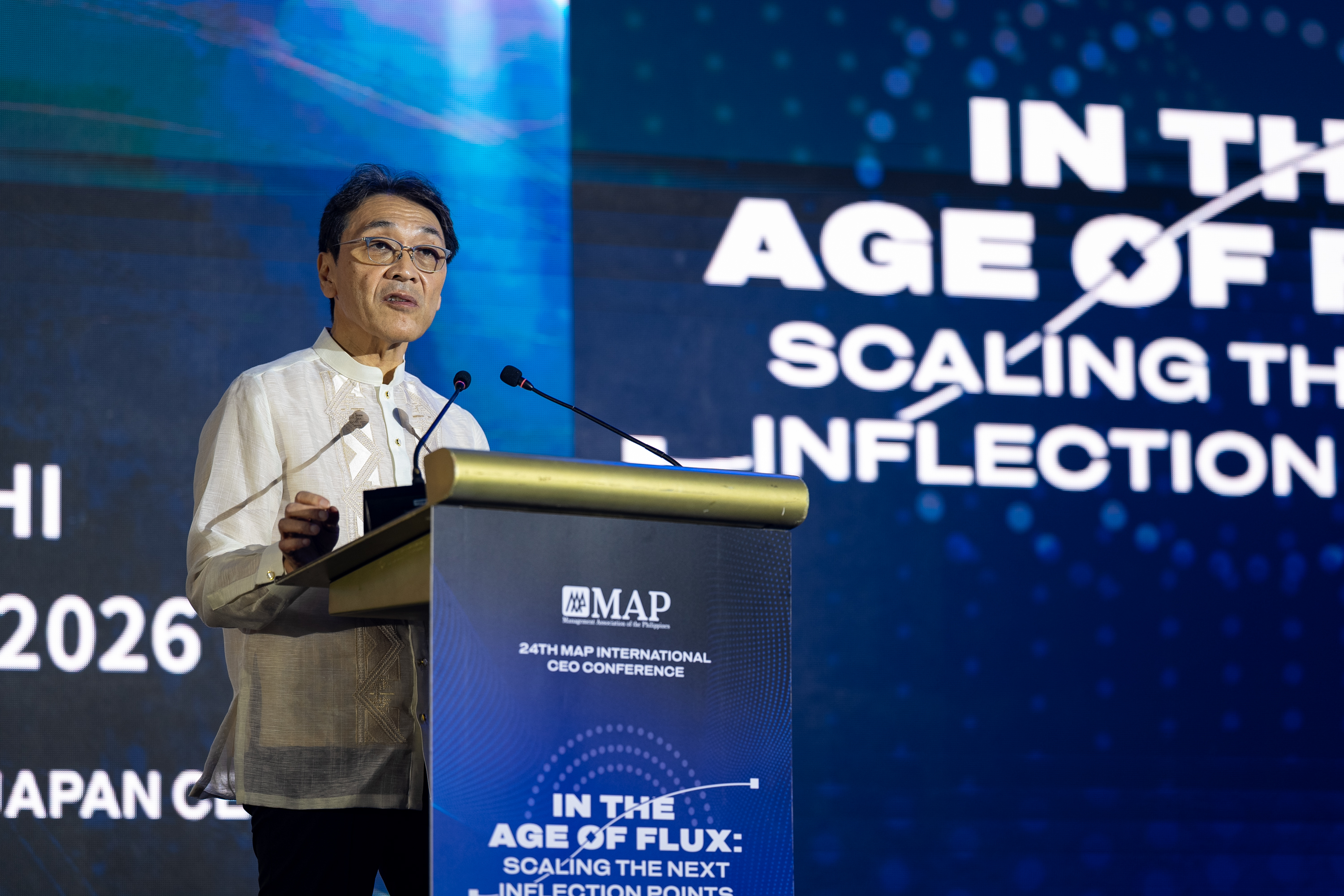
The ASEAN-Japan Centre travelled to Metro Manila from 8–9 September 2026 to support two back-to-back dialogues supporting: the 24th International CEO Conference of the Management Association of the Philippines (MAP), and the inaugural RCEP Business and Investment Summit, organised by the East Asia Business Council (EABC) Philippines.
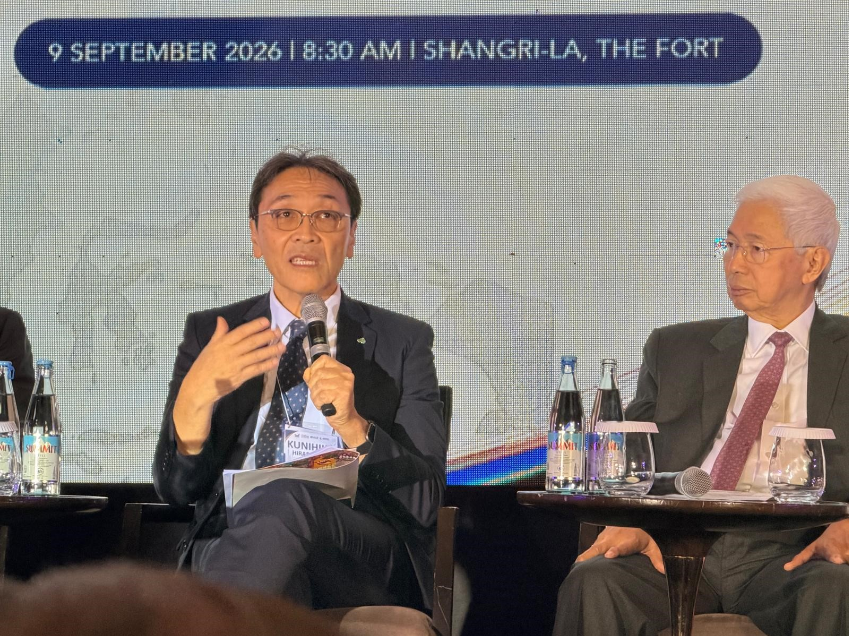
Secretary General Hirabayashi delivered the opening keynote at the MAP CEO Conference on 8 September, and the following day joined the RCEP Summit’s Track 4 panel, “Converting Advantage to Market Share: How Companies Are Winning with RCEP,” alongside senior voices from the Asian Development Bank (ADB), ISEAS–Yusof Ishak Institute, the Philippine Department of Trade and Industry (DTI), EABC member chambers, and regional industry. Across both platforms, the Centre advanced its distinct positioning as an advocate for inclusive, SME-supported FTA/EPA promotion — and gathered concrete, up-to-date data on how the Philippines and the wider region are actually putting RCEP to use.
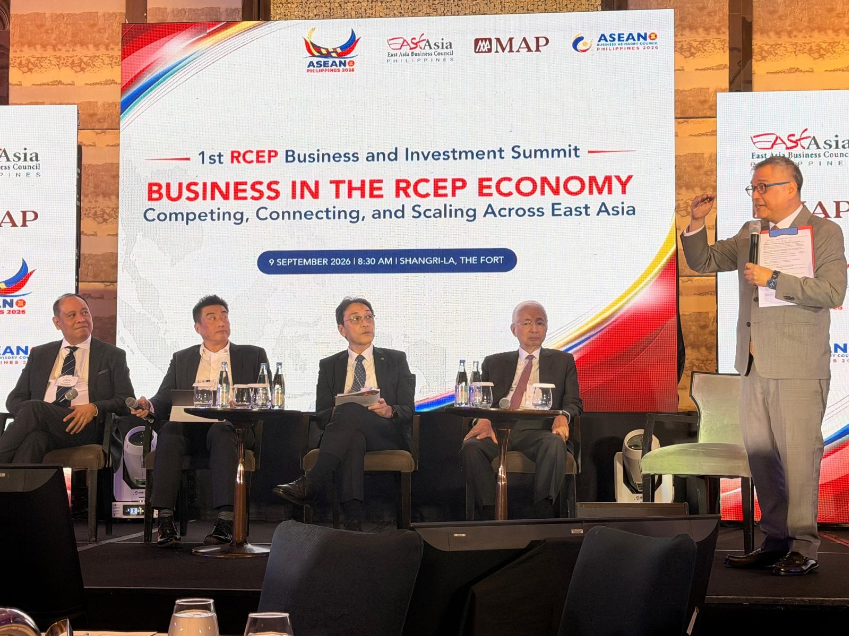
The Summit’s purpose was to identify how RCEP can be used more fully to expand ASEAN’s — and particularly the Philippines’ — potential by connecting more closely with the region’s larger economies. In line with its mandate to promote trade and investment between Japan and ASEAN, the Centre is proud to support the event and contribute as a panellist on Track 4: “Converting Advantage to Market Share: How Companies Are Winning with RCEP.”
Dr. Hirabayashi’s core message to the room was that the region no longer runs on a single trade platform:
“There is no longer just one highway. There are four — bilateral EPAs, AJCEP, RCEP, and CPTPP — and the winning move isn’t picking a favourite, it’s knowing which one to take for which shipment. AJC’s job isn’t to pick a lane for you. It’s to make sure every business — especially the ones most likely to be left standing at the on-ramp — can actually get on the road at all.”
— Dr. Kunihiko Hirabayashi, Secretary General, ASEAN-Japan Centre
He grounded this in the Centre’s on-the-ground work — hands-on FTA seminars run sector by sector, down to the paperwork, in Malaysia, the Philippines, Thailand, Viet Nam, Cambodia, and Lao PDR. His closing ask to EABC and the region’s larger corporations was direct: audit your own supply chains, find the SMEs feeding into them, and mentor and pull those businesses into your export value chain — turning large-corporate FTA/EPA usage into a distribution mechanism for smaller players who cannot access these benefits alone.
Key Discussion Findings
RCEP’s value lies in execution, not membership
Panellists converged on a shared diagnosis: RCEP’s tariff and rules-of-origin benefits mean little if firms, especially SMEs, don’t know how to use them. Mr. James Villafuerte (ADB) proposed EABC serve as a practical toolkit and collective voice for SMEs, handling business matching and supplier networking. Mr. Alfredo Pascual (former DTI Secretary) framed the next step as converting “RCEP understanding” into “real action” through predictable border requirements and capable-supplier development. Mr. Lennon Tan (EABC Singapore) proposed a concrete mechanism: a regional helpdesk and mutual recognition of testing, so a single certification could carry across markets instead of requiring duplicate paperwork.
Derisking, not decoupling, is the strategic response to a polarizing global market
Dr. Jayant Menon (ISEAS) identified the region’s core challenge: as major markets become more inward looking, ASEAN economies need to boost intra-regional trade and self-reliance, including linking RCEP with overlapping agreements such as CPTPP. Mr. Villafuerte reinforced this with a “derisking versus decoupling” framing, noting that major economies’ roles, such as China and the US, in regional supply-chain reconfiguration remains too significant to underestimate even amid diversification.
RCEP’s rules of origin are its most practical competitive advantage
Multiple industry voices identified origin cumulation, the ability to count inputs sourced from multiple RCEP economies as “originating”, as RCEP’s decisive edge over older bilateral deals. Mr. Sunil Nambiar (YCH Group) described this in operational terms: multi-country sourcing, multimodal super-ports in Vietnam and Cambodia, and integrated cross-border logistics data, while flagging data standardisation as the next unresolved layer. Mr. Jacob Lee (Federation of Malaysian Manufacturers) confirmed manufacturers are actively using this flexibility to diversify suppliers, while pushing for more SME-accessible compliance certification.
The Philippines is positioning RCEP for value-chain upgrading, not just trade volume
Ms. Sherlyn Aquia (DTI-BITR) outlined a shift in focus from basic utilisation to competitiveness and expansion — targeting electronics, advanced manufacturing, renewables, and digital services, with emerging ambitions in AI and cybersecurity. Larger Philippine firms are already active users, particularly for exports to Japan and Indonesia, where RCEP’s preferential terms now outperform the country’s older bilateral EPAs.
Beyond trade, RCEP is a platform for investment, talent, and sustainability
Mr. Jojo Flores (Plug and Play Ventures) argued the region’s real competitive challenge is for startup and FDI attraction, making regional storytelling essential. Dr. Hirabayashi pointed to Japan’s ageing, health-conscious consumer base as a durable demand driver for regional health and organic products, with SME and youth/women-led enterprise inclusion widening who benefits. Mr. Villafuerte tied this to climate, noting RCEP’s green provisions could become the operating channel for trading critical minerals and other sustainability-linked goods.
Underlying the discussion, data gathered across both platforms showed that underutilisation is broader than RCEP alone. Thailand claims preferential tariffs on 93.7% of eligible shipments to Japan across all its trade agreements combined — while in the Philippines, utilisation is low across essentially all its FTAs/EPAs (JPEPA 23%, AJCEP just over 1%, RCEP 0.82%). This points to a domestic capacity and translation gap rather than a weakness in any single agreement — and to a time-urgent case in Laos (graduating from LDC status in 2026) and Cambodia (graduating in 2029), whose exporters must build the compliance capacity to use RCEP on commercial terms before their current preferential access expires by default.
Conclusion
The Centre’s participation alongside EABC, AMRO, Japan Chamber of Commerce and Industry, and other regional bodies reinforced its position as a neutral co-creation platform and trusted partner in the emerging RCEP business ecosystem, opening concrete entry points for deeper cooperation with EABC and ASEAN+3 private-sector organisations. The mission also surfaced a clear next step for the Centre’s own programming: moving from broad, region-wide RCEP awareness toward a targeted methodology and specifying which sectors, firm types, and businesses within them stand to gain the most from closer support.
For more information:
info_rpa@asean.or.jp
Research and Policy Advocacy Team
ASEAN-Japan Centre


