Reported by Kolatat Katousano, Puthiphat jirawatanaphalin, Phattharapong Duangkham, Tinthai Bootseeta, Phuckjira Naphapunsakul (additional team member)
1 December 2025 – 30 June 2026 | Digital Economy Promotion Agency/DEPA (Headquarter) | 3,000 participants
Key takeaways
- Purpose-Driven Innovation at the Intersection of AI and Environmental Education
RIFFAI’s contribution to the AJYELN program demonstrated how artificial intelligence can be meaningfully applied to ocean plastic waste monitoring and environmental education. By transforming discarded materials into compelling learning tools, the initiative positioned technology as a practical, accessible driver of sustainability rather than an abstract or distant concept.
- Strengthened Environmental Literacy on Microplastics
Through lectures facilitated by AJYELN Thailand Fellows, participants developed a clearer and more concrete understanding of microplastics, including their pervasive presence in daily life and long-term impacts on marine ecosystems and human health. This contributed directly to heightened environmental literacy among students and youth participants.
- Behavioral Awareness and Momentum Toward Sustainable Practices
Beyond knowledge acquisition, the program encouraged a visible shift in attitudes toward single-use plastic consumption. Many participants expressed stronger intentions to reduce plastic use, explore alternative materials, and adopt more sustainable daily practices—highlighting the exhibition’s role in inspiring long-term environmental responsibility.
Main highlights
Date: 1 December 2025 – 30 June 2026 (on-going)
Venue: Digital Economy Promotion Agency/DEPA (Headquarter), 234/431 Building A, Ladprao Lane 10 Lat Phrao Rd, Chom Phon, Chatuchak, Bangkok 10900
Organizer and co-organizers: AJYELN Thailand Fellows (RIFFAI Company), satellite team
Participants: Students and youth participants from ASEAN and Japan, Environmental advocates, educators, members of the general public visiting the Digital Economy Promotion Agency (DEPA) headquarters
No. of participants: estimated 3,000 participants
Activities implemented
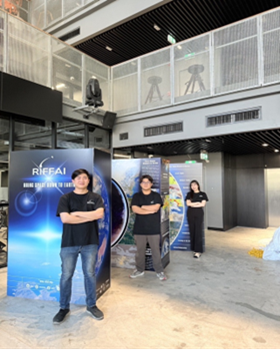
During the AJYELN event, RIFFAI, in collaboration with the Satellite Team, designed and implemented an interactive exhibition that integrated artificial intelligence with ocean waste materials as a core educational feature. Marine debris and plastic waste collected from coastal environments were repurposed into curated visual displays, supported by AI-assisted data interpretation and storytelling elements that translated complex environmental information into accessible narratives.
The exhibition functioned as both an educational and experiential learning space. Visitors were guided through a thematic journey tracing ocean waste from its origins in everyday consumption, to its accumulation in marine ecosystems, and finally to its transformation into a medium for learning, reflection, and innovation. By combining physical waste materials with AI- and satellite-based insights, participants were able to connect abstract environmental data with tangible, real-world impacts.
In parallel with the exhibition, AJYELN Fellows delivered structured lectures and facilitated discussions on microplastics, environmental risks, and sustainable alternatives. RIFFAI supported these sessions by providing concrete visual references from the exhibition, reinforcing theoretical concepts and making often-invisible issues—such as microplastic pollution—more immediate and relatable. Informal knowledge-sharing interactions and guided exhibition walkthroughs further encouraged dialogue and reflection on personal consumption behaviors.
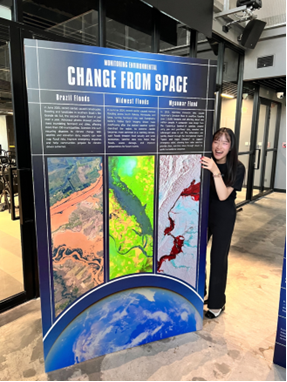
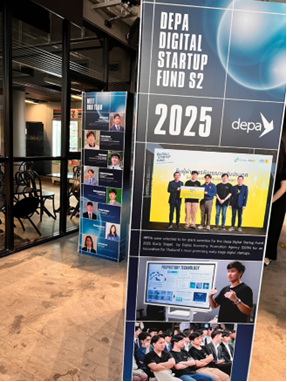
Figure 2 Exhibition space in DEPA
Since its opening on 1 December 2025, the exhibition has operated continuously and attracted a steady flow of visitors, averaging approximately 100 participants per day. Based on the current operational period, the exhibition has already engaged an estimated 3,000+ participants.
The extended exhibition period was intentionally designed to promote sustained public engagement rather than one-time outreach. By remaining open for several months, the initiative enables repeat visits by educational groups, long-term observation of learning outcomes, and deeper behavioral reflection. In this way, the exhibition functions as a living educational platform—continuously evolving through audience interaction while reinforcing AJYELN’s mission to empower youth leadership, promote environmental responsibility, and translate knowledge into action through technology-driven innovation.
Outcome and Feedback
Overall feedback from participants has been highly positive. Many visitors spent extended periods engaging with the exhibition, actively asking questions and participating in facilitated discussions. Survey responses and verbal feedback indicate that the exhibition significantly enhanced participants’ understanding of the scale and urgency of ocean plastic pollution, particularly the often-overlooked issue of microplastics and their presence in everyday life.
Participants consistently highlighted the effectiveness of integrating artificial intelligence, satellite imagery, and physical waste materials in communicating complex environmental concepts. This multidisciplinary approach was frequently cited as a key factor in making the learning experience both impactful and memorable, enabling visitors to link scientific information with tangible evidence.
Beyond awareness-raising, the exhibition prompted meaningful behavioral reflection. Many participants reported increased motivation to reduce plastic consumption, avoid single-use plastics, and explore sustainable alternatives in their daily routines. Continued engagement and feedback shared through social media further suggest that the exhibition’s influence extended beyond the physical space.
Overall, the project demonstrates that when environmental education is combined with technological innovation and youth-led engagement, it can move beyond information delivery to foster genuine behavioral change and long-term environmental stewardship.