Reported by
Mohammad Nurdhiyauddin bin Haji Nudin, Haji Muhammad Izzuddin bin Haji Nor Hisham, and Mohammad Wafiy Mustaqim bin Bahrin
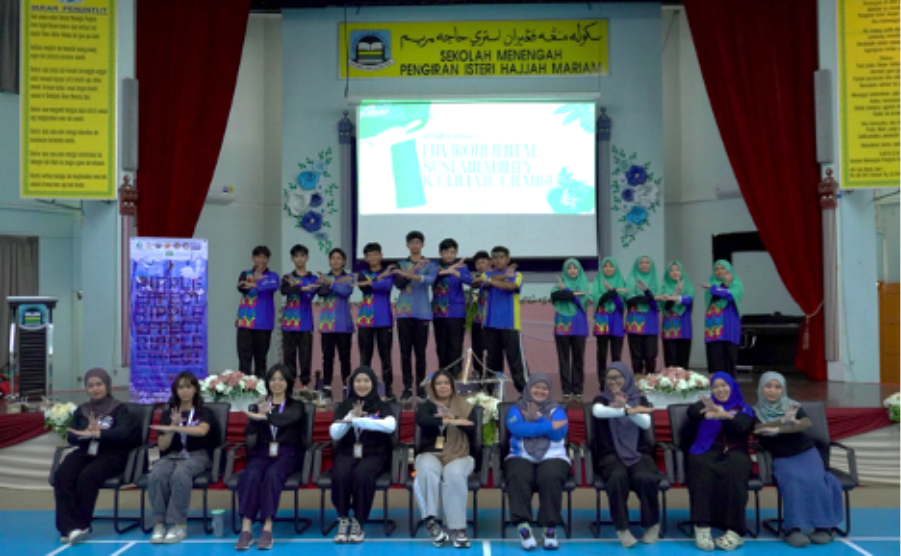
As a key implementation phase of Project Ripple Effect, participants who had completed the Masterclass Workshop Series—covering Leadership, Advocacy, Sustainability, and Environment—were tasked with translating their learning into real-world action through school-based outreach. In Brunei, three participant teams designed and delivered interactive environmental workshops for primary (8-12 years old), high school (12-16 years old), lower sixth-form (17-18 years old) students, aiming to raise early awareness of plastic pollution through engaging, age-appropriate activities. This report covers the workshop held in high school. The workshop aimed to engage students by combining educational talks with practical, hands-on activities, emphasizing how they can pursue academic interests and leadership roles related to environmental awareness in a college setting.
Key Takeaways
- Practical Waste Management Skills are Mastered: Students clearly learned how to sort and identify materials into the distinct categories of landfill, compostable, and recyclable through the competitive Sorting Game, and now also understand the concept of upcycling and can accurately differentiate it from recycling based on the informative talks.
- Theoretical Knowledge is Applied Through Creative Problem-Solving: Students successfully learned to apply theoretical environmental concepts to practical, real-world challenges by using recyclable materials to build mini bridges in the ‘Bridge O’ Trash’ Challenge, demonstrating incredible creativity and innovative use of materials in solving an engineering task.
- Environmental Advocacy and Teamwork are Linked to Fun Learning: Students learned that sustainability concepts can be fun and engaging when combined with teamwork and collaboration, as they actively discussed ideas and problem-solved together across multiple activities, while the motivational talk provided them with clear, actionable pathways to pursue environmental leadership through specific youth organizations.
Main Highlights
- Date: 13 November 2025 at 08:00 – 10:00 BNT
- Venue or location: Sekolah Menengah Pengiran Isteri Hajjah Mariam, Serasa, Brunei Darussalam
- Organizer: AJYELN Brunei: Din Din and Friend Team
- Facilitator: Project Ripple Effect participants: Sekolah Menengah Pengiran Isteri Hajjah Mariam, Serasa School
The workshop team was selected based on a prior pitch activity where members demonstrated their ability to tailor a project to a specific audience; hence, the organizers assigned the members based on the audience they initially targeted, using their established foundational knowledge. These included:
- Zara (Leader)
- Amal (Assistant Leader and Secretary)
- Syasya (Lead Administration and Floor Management)
- Mai (Lead Logistic)
- Fina (Assistant Logistic)
- Nadia (Project Coordinator and Graphic Designer)
- Participants: High school students ranging from Year 8 to Year 10 with their age range from 12 to 16 years old.
- No. of participants: 13 participants
Activities Implemented
The Project Ripple Effect participants hosted a two-hour interactive workshop targeting high school students, led by seven (7) participants and three (3) volunteers, and designed to promote environmental awareness through interactive learning and preparation for the transition to college life. The session began with an opening remark from the lead facilitator outlining the objectives, followed by group formation; however, due to a lower-than-expected turnout, the initial plan to organize students into 10 groups was adjusted to three groups to accommodate the 13 attendees efficiently. The activities and talks that was conducted are as follows:
- Activity 1: Crossword Activity
The initial activity served as an ice-breaker designed to introduce students to key sustainability concepts through a recycling-themed crossword puzzle. To ensure learning occurred simultaneously with problem-solving, detailed explanations of each sustainability concept were provided immediately below the puzzle, allowing students to not only find the terms but also grasp their meaning.
- ‘Creative Upcycling’ Talk by Syasya and Qilah
The second segment featured an informative sharing session dedicated to upcycling, demonstrating how various waste materials can be creatively and functionally transformed into new products, thereby highlighting the potential for waste reduction through innovative design and resourcefulness.
- Activity 2: Sorting Game
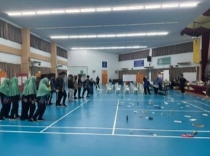
The second activity was an interactive, fast-paced game designed to teach students the correct separation of waste into compost, landfill, and recyclable categories. The three (3) student groups participated in a relay challenge where different types of waste were scattered across the floor. Each group member had just five (5) seconds to run, grab a single item, and place it into its correct category; failure to do so required them to drop the item where they stood and return to the line. Once all items were sorted, the facilitators meticulously audited the trash, providing immediate, item-by-item feedback and explanations on the correct categorization. This practical, competitive exercise effectively educated students on the distinctions between landfill-bound, compostable, and recyclable materials.
- ‘Grounded in Purpose’ Talk by Zara and Nadia
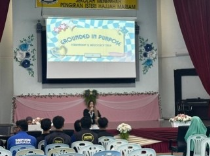
The subsequent session transitioned into a powerful motivational talk, specifically aimed at galvanizing youth participation in environmental protection and the adoption of sustainable living practices. To make the message tangible and inspiring, the talk showcased current youth leaders actively engaged in various organizations and advocacies. Crucially, it provided students with specific examples of organizations they could potentially join, thereby translating the motivational message into clear, actionable pathways for future involvement and leadership within the environmental movement.
- Activity 3: “Bridge O’ Trash” Challenge
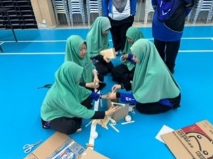
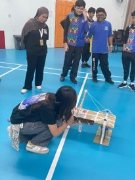
The final activity was a hands-on engineering challenge where the three (3) student groups were tasked with using only provided recyclable materials, such as cardboard boxes and wooden popsicle sticks, to build mini bridges. This activity was specifically designed to promote teamwork, creativity, and problem-solving skills. Before starting, the facilitators provided a reference example of a finished bridge to demonstrate the feasibility of the task using the given sustainable materials. Upon completion, the bridges were rigorously tested and examined based on several criteria: their ability to withstand a small force (pressure test), the efficiency of materials used, adherence to the design rules set by the facilitators, and overall creativity.
- Activity 4: Quiz
The final activity was a competitive, five-question, multiple-choice quiz on sustainability, structured as an interactive race. The three groups were lined up at one end of the room, while four facilitators held up signs labeled A, B, C, and D at the other end to represent the answer choices. For each question, the groups were given ten seconds to discuss and agree upon an answer. Following the discussion, one participant from each group had to race to the facilitator holding the chosen correct letter. The first participant to reach the correct answer won the point for their group, and the group accumulating the most correct answers was declared the overall winner.
Outcome
The workshop effectively met its core educational goals as outlined in the team’s proposal, successfully enhancing the students’ awareness and knowledge of various sustainability concepts through a blend of informative talks and engaging, interactive activities. The students actively participated in the discussions and Q&A sessions, demonstrating a genuine interest in the material. A particularly notable outcome was the successful fostering of teamwork and collaboration; throughout the activities, students actively discussed their ideas, showed concern for problem-solving, and worked together effectively to achieve common goals, showcasing the development of essential social skills alongside environmental learning.
Furthermore, the students displayed incredible creativity and innovation during Activity 3 (mini-bridge building), where they demonstrated practical application of the concepts learned in the upcycling talk. By using the recyclable materials provided, they creatively transformed waste into functional structures, illustrating the potential to apply theoretical environmental knowledge to solve real-world scenarios in the future. Beyond the curriculum, the workshop itself modelled sustainable behaviour by minimizing waste, prioritizing recycled and reusable materials in the setup and activities, and through the facilitators setting a positive example, such as using personal tumblers. This holistic approach reinforced the principles of sustainable living both through instruction and practice. Overall, the expected event outcomes for this workshop were successfully achieved despite the lower-than-expected number of participating students.
The team also faced substantial initial hurdles regarding internal communication and pre-workshop coordination, particularly evident in the official WhatsApp group. Initially, the team was the “most quiet with little to no response or concern” about their preparation progress. This lack of group communication stemmed from members primarily “communicating privately between each other,” resulting in fragmented updates that were often not “explained properly” for the main organizers. This silence required a “slight push” from the organizers five days before the event to initiate proper, collective communication. The issue was compounded by the fact that only half of the committee had prior event experience, and two experienced members were reportedly inactive. Subsequently, the team recognized this as a critical flaw, learning that they needed to “communicate more and asked each other’s commitments” to foster empathy and understanding rather than “ghosting questions in the group.”
During the workshop itself, there were several execution issues, including technical difficulties with the presentation slides at the start, which contributed to the workshop extending by “about 30 minutes” past the scheduled 10:00 AM end time. These technical setbacks could have been prevented had the team conducted necessary dry runs, which were omitted due to external “commitments and time constraints” like work, examinations, and assignments. Furthermore, the event suffered from a perceived initial lack of energy from some speakers, a sentiment shared by the volunteers, and the leader was noted as being “too soft and wasn’t engaging enough” at first. Compounding the issue were internal role confusion, where some members were uncertain of their teammates’ duties, and others were not fully prepared for their own activities or slides. Despite these operational flaws, the team’s ability to adapt well to the low attendance and the high level of active participation from the students ultimately ensured the workshop’s success in achieving its educational objectives.
As this workshop also posed as a hands-on activity for the facilitators, below are the 3 main outcomes of the facilitators (Project Ripple Effect participants):
- High-Quality Curriculum Design and Delivery: The facilitators were successful in designing and delivering a multi-faceted workshop curriculum that effectively blended informational talks (“Creative Upcycling,” “Grounded in Purpose”) with hands-on, highly interactive activities (Sorting Game, ‘Bridge O’ Trash’ Challenge, Quiz). This creative structure resulted in a “fun, engaging, and deeply educational experience” for the students, successfully achieving the core goal of enhancing environmental awareness and knowledge.
- Effective Adaptation to Unforeseen Circumstances: Despite the challenge of a significant disparity between the expected 50 students and the actual turnout of 13 participants, the team demonstrated commendable adaptability. They swiftly and effectively revised the group structure from 10 planned groups down to three, ensuring the activities remained manageable, engaging, and relevant for the attending students, thus preventing a potentially disruptive situation.
- Successful Modeling of Sustainable Practices: The facilitators went beyond teaching concepts by actively modeling sustainable behavior throughout the event. This was observed through the strategic use of recyclable and reusable materials for the activities and the personal example set by the facilitators (e.g., using personal tumblers). This deliberate effort reinforced the workshop’s theme and demonstrated a commitment to sustainable living practices.
Feedback
Given the restriction on high school students bringing personal phones, the facilitators opted to use traditional printed feedback forms to gather input from all 13 participants. One facilitator meticulously compiled the collected feedback into three comprehensive categories: Highlights, Learning Outcomes, and Improvement for Next Workshop. This methodical approach ensured all student comments were systematically organized for effective review, providing clear, structured insights into the success of the two-hour session and identifying areas for future enhancement.
The feedback overwhelmingly indicated a highly positive reception, with nearly all students reporting they had a great, enjoyable, and fun time, largely due to the activities being easy to follow and understand. A significant highlight was the diversity of activities, which students loved, specifically mentioning the crossword puzzle, the interactive sorting game, and the “Bridge o’ Trash Challenge.” The talks were also well-received, described as both informative and motivating. In terms of learning, students reported they now clearly understood the concept of upcycling and could accurately differentiate it from recycling. Crucially, they mastered the practical skill of sorting and identifying materials into the distinct categories of landfill, compostable, and recyclable, recognizing that combining creativity and teamwork made learning about sustainability highly engaging.
The primary suggestion for improvement was the request for more challenges focused on creativity and critical thinking, a desire that was unfortunately constrained by the limited two-hour session time. One student specifically suggested integrating a tech-based game to enhance visualization and interaction in future workshops. Reflecting on this input, it is evident that the team successfully delivered a fun, engaging, and deeply educational experience. The students not only grasped the core concepts but also genuinely enjoyed the process, achieving meaningful learning outcomes. This substantial positive feedback validates the team’s efforts and confirms the successful execution of the workshop objectives.