Full webinar recording: https://youtu.be/WvOiDNBOKvc
Overview
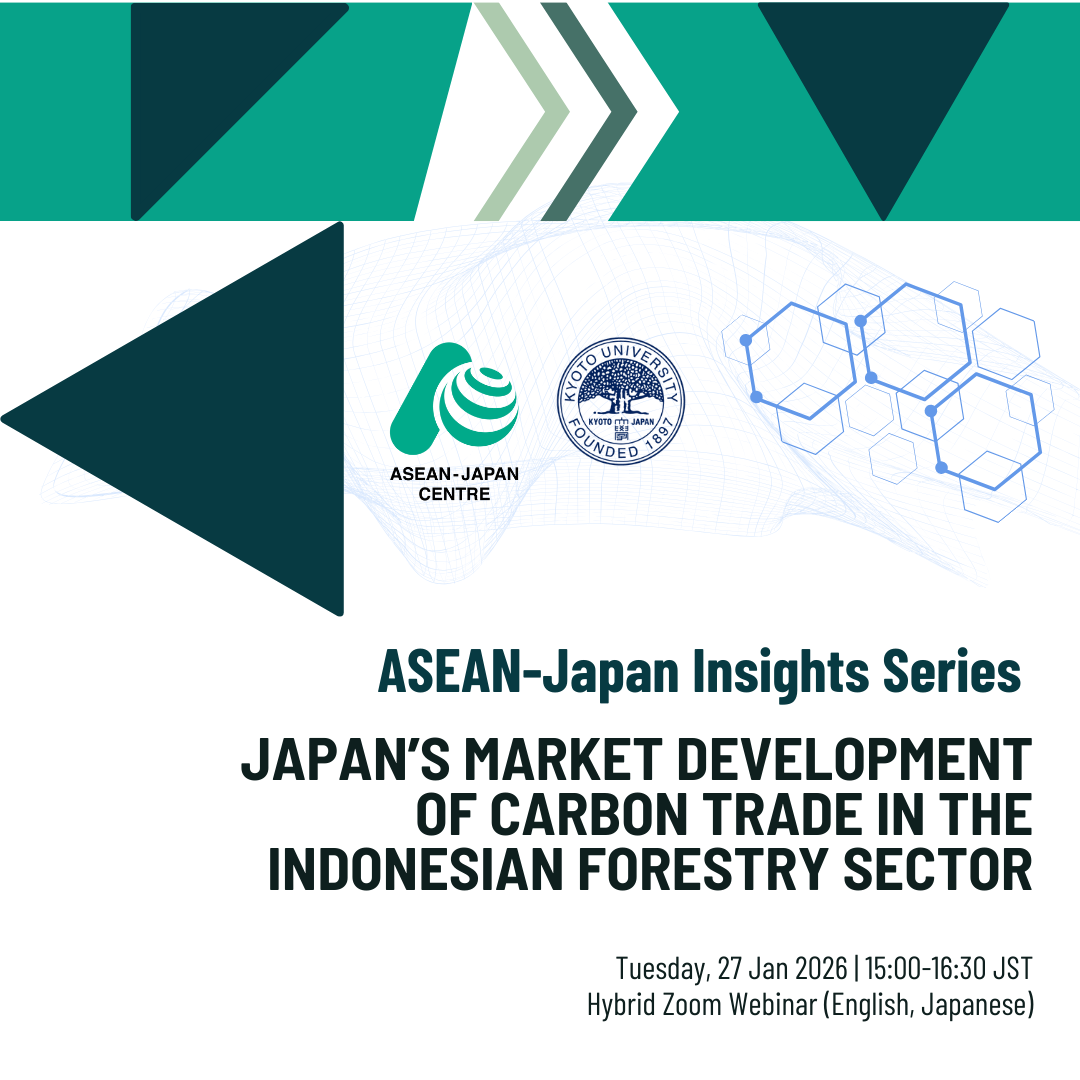
On 27 January 2026, the ASEAN-Japan Centre, in cooperation with the Kyoto University ASEAN Center, hosted the webinar “Japan’s Market Development of Carbon Trade in the Indonesian Forestry Sector” under the ASEAN-Japan Insights Series. The event brought together experts from the academic, private, and government sectors to identify practical pathways for strengthening high-integrity carbon markets and promoting sustainable, nature-based solutions across ASEAN and Japan.
Executive Summary
The webinar examined how Japan is advancing a high-integrity carbon market through the Joint Crediting Mechanism (JCM), linking international carbon projects with its national climate targets and domestic compliance system. Japan’s ambitious emissions-reduction goals are supported by integrating JCM credits into the GX-ETS from 2026, allowing companies to meet part of their obligations while contributing to regional decarbonization efforts aligned with the Paris Agreement.
The discussion also highlighted growing cooperation with Indonesia and ASEAN, particularly in the forestry sector, where safeguards, clear methodologies, and mutual recognition of credit systems are essential. Speakers emphasized both progress and challenges, including governance coordination, land tenure clarity, and benefit-sharing, while pointing to regional platforms such as the Asia Zero Emission Community (AZEC) as key to scaling credible and practical carbon markets across Asia.
The following speakers presented on the following topics:
- Hangga Prihatmaja, 2025 Research Fellow, ASEAN-Japan Young Experts Fellowship (AJYEF), highlighted the 2024 Japan–Indonesia Mutual Recognition Agreement as a key step in linking carbon credit systems, noting that market demand will rise from 2026 when JCM credits can be used for GX-ETS compliance. He also pointed to governance and coordination challenges in Indonesia’s forestry sector, emphasizing the need for clear joint committees and project methodologies to ensure credibility under Article 6. Link to Presentation: Link
- Keitaro TSUJI, Director of the Office for the Joint Crediting Mechanism and International Carbon Market, Ministry of Environment (Japan), explained Japan’s plan to scale the JCM to deliver large emissions reductions by 2030 and 2040, supported by a growing pipeline of non-subsidy projects. He stressed that new institutions, forestry guidelines, and safeguards are in place to ensure integrity, with the issuance of the first ITMOs marking a major milestone. Link to Presentation: Link
- Nurul Iman Suansa, Senior Technical Specialist at ACT Group, focused on what makes forest carbon projects investable, stressing the shift toward high-integrity credits backed by strong legal clarity, MRV, and land tenure certainty. He called for closer integration of Indonesian and Japanese systems and suggested piloting a small group of projects before scaling up. Link to Presentation: Link
- Dr. M. Zahrul Muttaqin, Co-Director of the Multistakeholder Forestry Programme Phase 5 (MFP5), outlined the core principles of forest carbon integrity and shared lessons from Indonesia’s REDD+ experience, including performance-based results at the provincial level. He emphasized that clear land and carbon rights, better data access, and stronger regional MRV systems are critical for credible and inclusive carbon markets. Link to Presentation: Link
Here are the main takeaways from the presentations:
- Using international credits to support Japan’s climate goals
Japan is strengthening its path to net zero by 2050 by allowing companies to use JCM credits under its GX-ETS from 2026, making international carbon projects part of its domestic climate action.
- Stronger Japan–Indonesia coordination on carbon markets
The 2024 Mutual Recognition Arrangement allows Japan to recognize Indonesia’s carbon credits, especially in forestry and waste, though clear roles and coordination in Indonesia remain important for smooth implementation.
- A functioning Article 6 carbon trading system
The JCM is now fully aligned with the Paris Agreement, with the first international credit transfers completed in Thailand and the Maldives, showing that the system works in practice.
- High standards for forest-based carbon projects
Japan has introduced dedicated rules for forestry projects to ensure environmental protection, safeguard local and Indigenous communities, and prevent double counting of emissions reductions.
- Focus on quality and investability
Attention is shifting toward high-quality, credible carbon projects, making clear land tenure, reliable monitoring, linked registries, and fair benefit-sharing essential before scaling up across Indonesia’s forestry sector.
Meanwhile, the following are some of the critical points highlighted during the panel discussion, moderated by Dr. Gregory Trencher, Associate Professor at the Graduate School of Global Environmental Studies, Kyoto University:
- Policy design drives market participation
Japan’s GX policy and ETS were identified as major drivers of international carbon trade, with the forestry sector seen as especially important for supplying credits to hard-to-abate industries once private firms are fully mobilized.
- Managing investor risk is essential
Panelists stressed the need for phased investment approaches that clarify land tenure early and for alignment with global integrity standards to reduce financial and reputational risks.
- Addressing technical and governance gaps
Overlapping institutions, limited local technical capacity, and heavy reliance on international auditors remain challenges, highlighting the need for shared regional MRV systems and data platforms.
- Strengthening community involvement
Effective carbon projects require moving beyond consultation toward shared governance with local and Indigenous communities, supported by clearer, culturally appropriate communication tools.
- Start small to scale effectively
Rather than waiting for perfect regulatory conditions, speakers recommended piloting a small group of projects to test methodologies, regulations, and coordination mechanisms before expanding at scale.
Looking Ahead: Scaling Japan–Indonesia Carbon Cooperation
The next phase of Japan–Indonesia carbon trade will be shaped by the launch of Japan’s GX-ETS in 2026, which is expected to increase private sector demand for forestry-based carbon credits. To support this, closer coordination between Japan and Indonesia will be needed to fully implement the mutual recognition of carbon credits and adapt to Indonesia’s evolving governance structure.
In the near term, speakers emphasized starting small and practical—testing a limited number of pilot projects to ensure registries, approvals, and safeguards work smoothly in practice. As the system matures, strong monitoring, clear land rights, and meaningful involvement of local communities will be essential, with regional platforms such as AZEC helping to scale credible and high-integrity carbon markets across ASEAN.
About the ASEAN-Japan Insights Series
The ASEAN-Japan Insights Series is the Centre’s flagship bilingual platform for knowledge sharing on topics of strategic importance to ASEAN and Japan. The Series brings together experts from industry, academia, government, and research institutions to explore key issues shaping regional cooperation and future growth.
About the ASEAN-Japan Young Experts Fellowship (AJYEF) Programme
The ASEAN-Japan Young Experts Fellowship (AJYEF) Programme is a pioneering initiative of the ASEAN-Japan Centre that nurtures the next generation of thought leaders and practitioners in ASEAN-Japan relations. Through research, professional development, and engagement in policy dialogues, AJYEF Fellows contribute fresh perspectives on regional cooperation, emerging economic opportunities, and shared challenges.
For inquiries or participation in future webinars, please contact the Research and Policy Advocacy Cluster at info_rpa@asean.or.jp.