Full webinar recording: https://www.youtube.com/live/xuaaXDwcYFg
Overview
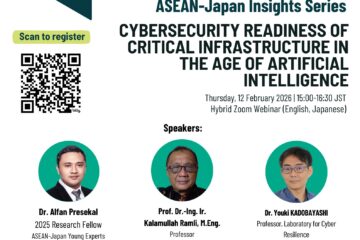
On 12 February 2026, the ASEAN-Japan Centre, in cooperation with the ASEAN-Japan Cybersecurity Capacity Building Centre (AJCCBC), hosted the webinar “Cybersecurity Readiness of Critical Infrastructure in the Age of Artificial Intelligence” under the ASEAN-Japan Insights Series. The session touched on emerging risks, policy alignment, capacity building, and the role of regional collaboration across public, private, and academic sectors in addressing evolving cyber threats.
Executive Summary
The webinar explored how ASEAN and Japan are strengthening cybersecurity readiness for critical infrastructure in the age of artificial intelligence, highlighting the need for closer cross-border cooperation to protect essential sectors such as energy, transport, telecommunications, and finance from escalating digital threats. Discussions pointed to a clear readiness gap: while Japan demonstrates a higher level of cybersecurity maturity than the ASEAN average, both regions face persistent vulnerabilities. A key challenge identified was the shortage of skilled human resources and technical expertise, with many stakeholders citing limited capacity as a major barrier to building digital resilience.
The session also underscored the dual role of AI as both a defensive tool and a source of emerging risks. While AI enhances threat detection and predictive defense, it also enables more sophisticated attacks such as AI-driven phishing and deepfake deception. Participants emphasized the need to address regulatory divergence, strengthen incident coordination, and advance a shared cybersecurity roadmap featuring common standards and sustained regional capacity building to support a secure and resilient digital environment across ASEAN and Japan.
The following speakers presented on the following topics:
- Dr. Alfan Presekal, 2025 Research Fellow, ASEAN-Japan Young Experts Fellowship (AJYEF) Program, presented a six-point cybersecurity readiness indicator framework including monitoring capabilities, data quality, human resources, infrastructure modernity, policy alignment, and incident coordination. Utilizing this framework in his survey, he found that among the respondents in Japan and ASEAN, there is a huge readiness gap in human resource and incident coordination. Emphasizing that while Japan exhibits higher maturity, both regions are primarily hindered by a critical shortage of technical skills and human resources. To bridge these vulnerabilities, he proposed a unified regional strategy that leverages AI for threat detection and anomaly monitoring alongside standardized incident reporting. Link to Presentation: Link
- Prof. Dr.-Ing. Ir. Kalamullah Ramli, M.Eng., Professor at the University of Indonesia, noted that Indonesia’s digital resilience is weakened by gaps in enforcing data protection laws and limited public awareness of privacy rights. He described artificial intelligence as a “double-edged sword” that enhances threat detection while also enabling deepfakes and advanced spear-phishing attacks. To strengthen resilience, he recommended adopting a comprehensive digital risk management framework and investing in secure, sustainable Digital Public Infrastructure (DPI). Link to Presentation: Link
- Dr. Youki KADOBAYASHI, Professor at the Nara Institute of Science and Technology (NAIST), Laboratory for Cyber Resilience, advocated for a shared cybersecurity architecture for ASEAN and Japan focused on policy alignment, standardized incident reporting, and regional capacity building. He cautioned that regulatory divergence disincentivizes cross-border investment and urged the region not to wait for legal frameworks to begin collaborating against imminent and growing digital threats. He also promoted cyber inclusion, viewing cybersecurity as a shared social value that requires open and participatory engagement across all sectors of society. Link to Presentation: Link
Here are the main takeaways from the presentations:
- Readiness Gap Across the Region
A significant cybersecurity readiness gap exists between Japan and ASEAN. Research indicates that Japan maintains a higher overall maturity index of 3.15 compared to the ASEAN average of 2.18 across indicators such as monitoring capability and infrastructure modernity. This disparity highlights an urgent need for ASEAN member states to address specific vulnerabilities in their critical infrastructure to achieve regional digital resilience.
- Human Capital as the Primary Bottleneck
The shortage of human resource skills is the primary barrier to digital resilience. Nearly half of the organizations surveyed identified a critical lack of technical expertise and limited resources as their most significant bottleneck. Consequently, experts recommend prioritizing regional capacity building through joint training, shared certifications, and collaborative exercises to cultivate a robust talent base.
- AI as a Double-Edged Sword
Artificial Intelligence is a “double-edged sword” that necessitates advanced governance. While AI enhances security through predictive analytics and automated threat detection, it also empowers malicious actors to execute sophisticated deepfake attacks and highly effective AI-powered spear phishing. To counter these risks, it is essential to integrate AI governance into national policies and implement privacy-preserving AI for cross-border threat detection.
- Regulatory Divergence and Coordination Challenges
Regulatory divergence across the region disincentivizes investment and coordination. Inconsistent laws regarding data privacy and incident reporting create a fragmented landscape that complicates cross-border business operations and response efforts. Standardizing incident reporting frameworks and aligning regional policies are vital steps to enable a more unified and efficient response to imminent digital threats.
- Toward a Shared Cybersecurity Architecture
Building a shared cybersecurity architecture is essential for interconnected infrastructure. The increasing connectivity of sectors like the proposed ASEAN “Supergrid” means that a failure in one nation could trigger a cascading regional crisis. This shared architecture must promote cyber inclusion, treating cybersecurity as a participatory social value that involves diverse stakeholders from across all sectors of society.
Meanwhile, the following are some of the critical points highlighted during the panel discussion, moderated by Mr. Mark Bryan Manantan, Research Fellow at La Trobe University:
- Reluctance to Deploy AI in Critical Infrastructure
Operators remain hesitant to integrate AI into operational technology (OT) systems because these environments require domain-specific expertise and high-quality data that are far more limited than those available for general IT applications. While AI capabilities are advancing rapidly, deployment in critical infrastructure must be carefully regulated and evaluated step-by-step rather than rushed.
- Internal Risks in AI Governance
Critical vulnerabilities exist in internal AI use, including data poisoning through manipulated training datasets and insufficient containment of AI agents that may gain broad, unauthorized access to critical networks. There are also potential blind spots in anomaly detection, as organizations often fail to monitor their own AI systems for signs of compromise.
- Bridging the Sovereignty–Integration Gap
Addressing tensions between national digital sovereignty and regional economic integration requires collaborative policy research and dialogue. Encouraging exchanges among students, researchers, and policy institutions across Asia can help nurture a shared regional vision and build consensus on digital governance approaches.
- Prioritizing Preventive Action
The discussion emphasized that ASEAN should not wait for a major triggering event—such as a regional blackout or large-scale cyber crisis—before aligning incident reporting standards. A preventive rather than reactive approach is needed, prioritizing OT security and shared frameworks before catastrophic disruptions occur.
- Interconnected Systems and a “Network of Trust”
As smart city systems integrate energy, transport, and public services, the overall attack surface expands significantly. Managing this risk requires building a strong network of trust and joint risk management strategies among industries that have traditionally operated in silos.
Building a Resilient Digital Future: A Joint ASEAN–Japan Cybersecurity Roadmap
Looking ahead, the ASEAN–Japan region is moving toward a “preventive instead of cure” approach through a phased joint cybersecurity roadmap that prioritizes Digital Public Infrastructure (DPI). Integrating Artificial Intelligence for predictive analytics and automated threat detection can strengthen resilience, but it must be supported by strong governance to address risks such as deepfakes and advanced spear phishing. Establishing a unified framework for classifying critical infrastructure and standardizing cross-border incident reporting will also help reduce regulatory divergence and improve collective response.
Sustaining this resilience requires closing the human resource gap, identified as a key barrier to readiness. Expanding regional capacity-building programs, including initiatives led by the ASEAN-Japan Cybersecurity Community Alliance, can foster a shared talent base and a trusted professional network across critical sectors. Ultimately, strengthening cooperation will help embed cybersecurity as a shared social value and support a secure, inclusive digital future.
About the ASEAN-Japan Insights Series
The ASEAN-Japan Insights Series is the Centre’s flagship bilingual platform for knowledge sharing on topics of strategic importance to ASEAN and Japan. The Series brings together experts from industry, academia, government, and research institutions to explore key issues shaping regional cooperation and future growth.
About the ASEAN-Japan Young Experts Fellowship (AJYEF) Programme
The ASEAN-Japan Young Experts Fellowship (AJYEF) Programme is a pioneering initiative of the ASEAN-Japan Centre that nurtures the next generation of thought leaders and practitioners in ASEAN-Japan relations. Through research, professional development, and engagement in policy dialogues, AJYEF Fellows contribute fresh perspectives on regional cooperation, emerging economic opportunities, and shared challenges.
For inquiries or participation in future webinars, please contact the Research and Policy Advocacy Cluster at info_rpa@asean.or.jp.