

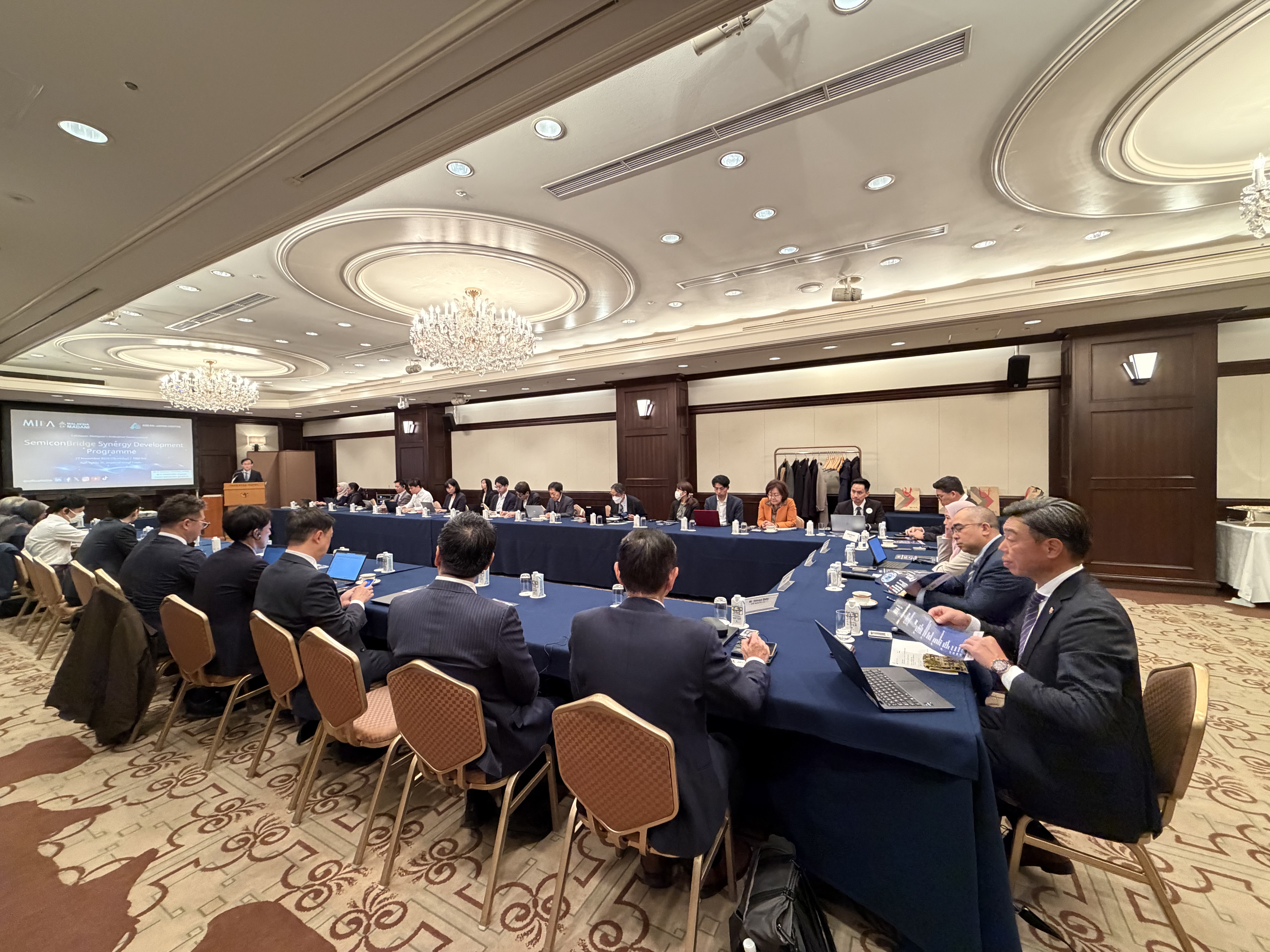
ASEAN-Japan Centre (AJC), in partnership with the Malaysian Investment Development Authority (MIDA), successfully organized the SemiconChem Synergy Development Seminar on 27 November 2025 in Tokyo.
The event was aimed to introduce Malaysia’s latest industrial developments, business opportunities, and ecosystem strengths in the semiconductor and chemical sectors. Thirty-three Japanese companies and related organisations attended the seminar.
The seminar brought together Japanese corporations, industry associations, and potential investors who are exploring opportunities in advanced manufacturing, semiconductor-related technologies, specialty chemicals, and industrial park development.
Highlights of the Seminar
Opening Remarks
The seminar began with welcome remarks by Mr. Chairat Liengkajornkiet, Director of Programme Operations at the ASEAN-Japan Centre. He emphasized the growing importance of Malaysia–Japan collaboration in strengthening regional supply chain resilience, especially in the semiconductor and chemical sectors—both of which are gaining prominence under Malaysia’s National Semiconductor Strategy (NSS) and New Industrial Master Plan (NIMP) 2030.

Presentation by MIDA: SemiconBridge Synergy Development Programme
Ms. Zetty Hamimi Zakaria, Deputy Director of the E&E Division of MIDA, introduced the SemiconBridge Synergy Development Programme, highlighting Malaysia’s evolving semiconductor ecosystem, talent pipeline, and growth in high-value manufacturing.
- Malaysia’s position as the 6th largest global exporter of semiconductors, and its expanding role in front-end and back-end semiconductor activities.
- Strong industrial clusters in Penang, Selangor, Johor, and Negeri Sembilan.
- Significant growth in approved investments in the E&E sector, driven largely by Foreign Direct Investment (FDI).
- Business opportunities across IC design, advanced packaging, equipment localization, and specialty chemicals.
- Government support including investment incentives, tax benefits, industrial infrastructure, and innovation-led development programs.
The presentation also showcased opportunities arising from Malaysia’s Chemical Industry Roadmap (CIR 2030), particularly in specialty and electronic chemicals that support semiconductor manufacturing.
Business Experience in Malaysia
NHK Spring, automotive product maker, shared the company’s long-standing manufacturing experience in Malaysia.
- Its 30-year presence in Negeri Sembilan producing metal-based printed wiring boards (PWB) and Integrated Metal Substrates (IMS).
- Malaysia’s advantages including political stability, talent availability, English proficiency, and strong government support.
- The company’s ongoing expansion project, including a new production building completed in 2024 to meet growing global demand for high-performance substrates used in EVs, consumer electronics, and renewable energy systems.
NHK emphasized that Malaysia remains an ideal base for Japanese companies expanding in the semiconductor material and component space.
EcoWorld: Sustainable Industrial Park Development
Dato’ Ho Kwee Hong, Divisional General Manager of EcoWorld, introduced EcoWorld’s industrial and business park projects across Malaysia.
- Eco Business Parks is designed for light and medium industries, with a focus on sustainability, efficient infrastructure, and flexible built-to-suit options.
- Comprehensive one-stop support including licensing assistance, recruitment support, advisory renovation, and incentive navigation.
- Strategic locations near major highways, seaports, and airports contribute to efficient logistics and supply chain operations.
EcoWorld’s developments, particularly in Johor and Negeri Sembilan, offer attractive solutions for Japanese manufacturers seeking expansion in ASEAN.
Way Forward
The ASEAN-Japan Centre together with MIDA Tokyo will continue to collaborate in promoting Malaysia’s high-value investment opportunities to Japanese corporations.


